
Introduction
In the competitive outdoor textile industry, “Printing” is no longer a single category. For procurement managers, selecting the wrong technology can lead to two supply chain disasters: fading inventory (due to poor UV resistance) or dead stock (due to MOQs that are too high for market demand).
At IgerEnjoy, we have observed that 2025 sourcing strategies are shifting. Buyers are no longer just asking “How much?”—they are asking “How fast?” and “How durable?”.
This guide provides a comprehensive comparison of the three dominant Outdoor Fabric Printing Methods: Heat Transfer (Dye-Sublimation), Rotary Screen Printing, and Digital Direct. We will analyze each based on Cost, MOQ, and AATCC 16.3 standards to help you make the right choice for your next collection.
1. The Three Giants Defined
Before talking price, we must define the technology, as “Heat Transfer” in outdoor fabric differs significantly from T-shirt vinyl.
A. Heat Transfer (Dye-Sublimation): The Modern Standard
Artwork is first printed onto special transfer paper. The paper and polyester fabric are then run through a high-heat calender machine (200°C+). The ink turns into gas and infuses into the fiber.
Best for: Polyester/Olefin fabrics, complex multi-color designs, photorealistic prints.
B. Traditional Screen Printing (Rotary/Flatbed): The Volume King
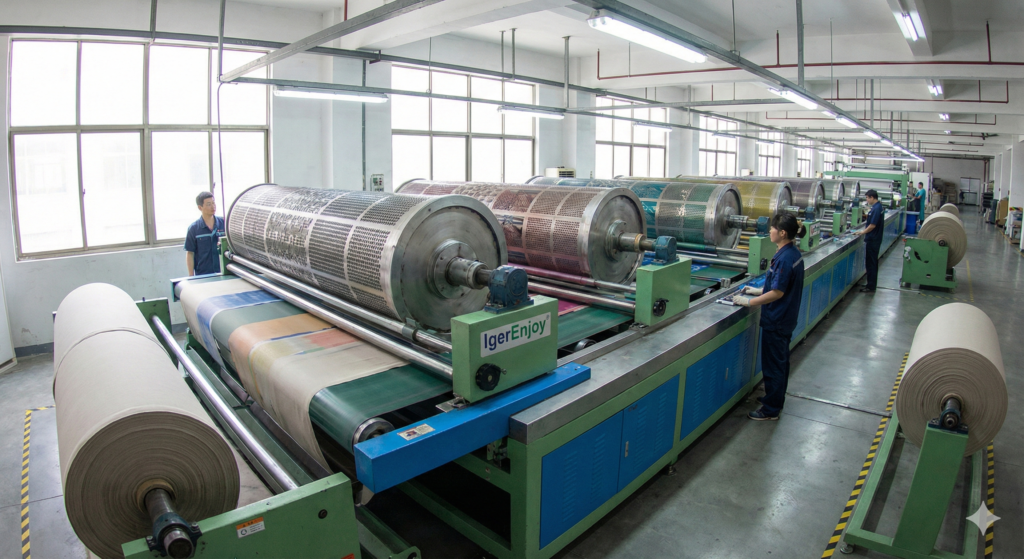
Screens (mesh stencils) are engraved for each color. Ink is pushed through the mesh onto the fabric surface. Rotary Screen uses cylindrical screens for continuous rolls, while Flatbed Screen is used for placement prints.
Best for: Simple geometric patterns, huge volumes (>1,000m), and maximum UV stability using pigment inks.
C. Digital Direct (DTF/Inkjet): The Natural Choice
Similar to an office printer but industrial-sized. Print heads jet ink directly onto pre-treated fabric.
Best for: Natural fibers (Cotton, Linen blends) where heat transfer isn’t possible.
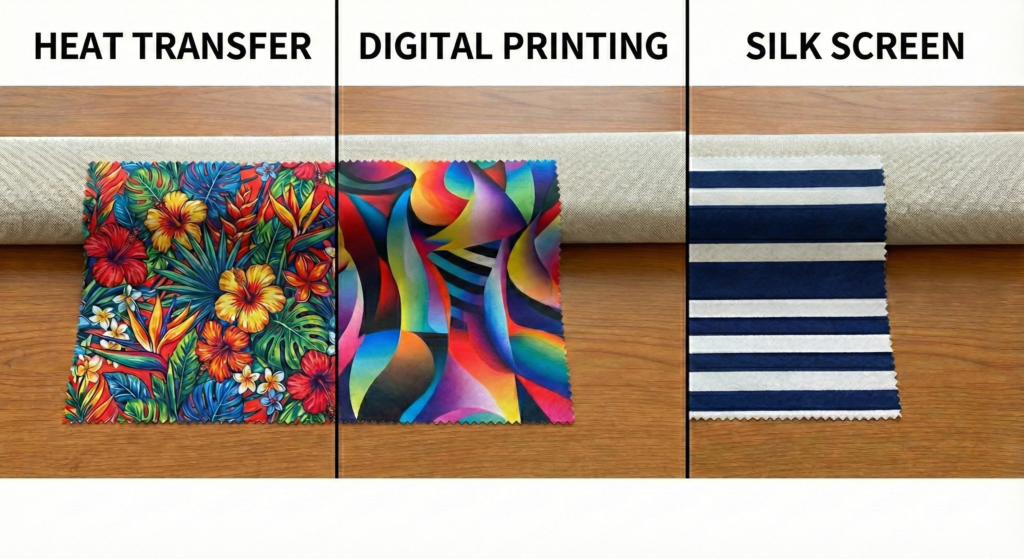
2. Decision Matrix: Comparing Outdoor Fabric Printing Methods
This table is your “Cheat Sheet” for 2025 sourcing.
| Feature | Heat Transfer (Dye-Sub) | Rotary Screen Printing | Digital Direct (Inkjet) |
| MOQ (Min Order) | Low (100 – 300 meters) | High (1,000+ meters) | Ultra Low (< 50 meters) |
| Setup Cost | Low (Paper cost only) | High ($100-$150 per color) | Zero |
| Colors/Design | Unlimited, Gradients, Photos | Max 8-12 Colors, No gradients | Unlimited |
| UV Resistance | Good (Requires High-Energy Ink) | Excellent (Pigment Ink) | Variable (Depends on Ink) |
| Hand Feel | Softest (Ink in fiber) | Stiff (Ink on surface) | Soft |
| Cost Efficiency | Best for < 2,000m | Best for > 2,000m | Most Expensive per meter |
Critical Warning on UV: Traditional Screen Printing using Pigment Inks naturally has better UV resistance (often Grade 4.5+ @ 1000 hours) than standard Dye-Sub. If you choose Heat Transfer for outdoor use, you must specify “High-Energy Disperse Dyes” to ensure your products pass AATCC 16.3 testing.
3. Buyer Scenarios: Which One Are You?
Choosing among different outdoor fabric printing methods often depends on your business model.
Scenario A: The “Fast Fashion” Outdoor Brand
Your Profile: You launch 2-4 collections a year. You need to follow trends like “Biophilic Ferns” quickly without risking 5,000 meters of stock.
Recommendation: Heat Transfer (Dye-Sublimation).
Why: Speed (7-day lead time) and visual quality (perfect for gradients).
Scenario B: The Big-Box Retailer
Your Profile: You are buying for Walmart or Costco. You have a fixed design (e.g., a simple Cabana Stripe) and need 20,000 meters at the lowest possible price.
Recommendation: Rotary Screen Printing.
Why: Lowest per-meter cost and consistent color across massive runs.
Scenario C: The Luxury Resort Project
Your Profile: You need branded umbrellas with a specific logo printed on the center of each panel.
Recommendation: Flatbed Silk Screen (Panel Printing).
Why: It allows for precise placement prints (non-repeating) and high opacity white ink on dark fabrics.
4. Technical Deep Dive: Quality Control
When inspecting your goods, knowing the specific weaknesses of various outdoor fabric printing methods can save you thousands of dollars. Here is what our IgerEnjoy QC team looks for:
Ghosting (Heat Transfer Issue): A slight double-image effect caused if the transfer paper shifts during the pressing process. This is a critical failure in digital methods.
Misfit/Trapping (Screen Printing Issue): Where two colors meet, there might be a tiny white gap if the screens are not perfectly aligned. High-quality rotary screen printing requires precise calibration to avoid this.
Banding (Digital Direct Issue): Visible horizontal lines across the fabric, usually caused by a clogged printhead.

5. Sustainability: Which Method is “Greener”?
In 2025, European buyers (EU) are increasingly asking about the environmental impact of outdoor fabric printing methods.
Water Usage: Heat Transfer (Dye-Sub) is the winner here. It is often called “waterless printing” because the paper transfer process requires zero water for washing or steaming post-print.
Chemical Waste: Rotary Screen requires washing the screens and pipes between color changes, generating wastewater. However, IgerEnjoy utilizes a closed-loop water filtration system to mitigate this.
Energy: Digital Direct is energy efficient for small runs but becomes energy-intensive for mass production compared to the speed of rotary machines.
6. The IgerEnjoy Solution: The Hybrid Strategy
Many savvy buyers are now using a Hybrid Strategy:
Market Test: Use Heat Transfer to produce 200m of 5 different designs.
Feedback: See which design wins (e.g., “The Blue Palm”).
Mass Production: Switch that one winning design to Rotary Screen for the bulk order to maximize margin.
Why Source from IgerEnjoy?
Vertical Integration: We weave the base fabric (Olefin/Polyester) and control the printing process.
Lab Verified: Internal testing for AATCC 16.3 compliance before shipment.
Design Library: Access to thousands of royalty-free, trend-ready outdoor patterns.
Conclusion
Whether you prioritize speed, cost, or sustainability, understanding the nuances of these outdoor fabric printing methods is key to a profitable 2025.
Choose Heat Transfer for Complexity & Low MOQ.
Choose Rotary Screen for Volume & Max UV.
Still Unsure?
[Contact IgerEnjoy today] to get our Free Swatch Book comparing Screen vs. Digital prints, or send us your artwork for a quick technical assessment.
Module C: Technical Setup
FAQ Schema Content
Q: Which outdoor fabric printing methods have the best UV resistance?
A: Generally, Rotary Screen Printing with Pigment Inks offers the highest natural UV resistance. However, Heat Transfer using High-Energy UV inks is now a very close second and suitable for most residential applications (AATCC 16.3 Grade 4).
Q: What is the difference between Digital Direct and Heat Transfer?
A: Heat Transfer (Dye-Sub) prints on paper first and transfers to fabric (best for Polyester). Digital Direct jets ink straight onto the fabric (better for Cotton/Blends but requires expensive pre-treatment).
Q: When is Rotary Screen printing cheaper than Digital?
A: Typically, the break-even point is around 1,500 to 2,000 meters. Below this, the screen setup fees make it expensive. Above this, the low running cost makes it cheaper than digital.IgerEnIgerrIger