
For procurement managers, hospitality directors, and outdoor furniture distributors, making the wrong purchasing decision can cost thousands of dollars in replacements and potential liabilities. When browsing catalogs, the visual distinction between shade structures can be deceiving. Understanding the core technical differences between commercial vs residential umbrellas is essential for protecting your bottom line and ensuring guest safety.
Deploying a residential-grade product in a bustling restaurant patio or resort pool deck inevitably leads to snapped poles, faded fabrics, and dangerous wind-related accidents. In this comprehensive guide, we will break down the material science, wind safety standards, and long-term ROI that B2B buyers must know before placing a bulk order.
Defining the Core Concepts: What Are We Comparing?
Before diving into the specifications, it is crucial to establish clear definitions for both categories.
What is a Commercial Umbrella?
A commercial umbrella is a heavy-duty, meticulously engineered shade structure designed for continuous, daily use in high-traffic public environments (such as hotels, cafes, and municipal parks). It is characterized by industrial-grade materials like thick-walled extruded aluminum, solid fiberglass ribs, and UV-resistant performance fabrics. Crucially, true commercial models undergo rigorous standardized wind testing to ensure structural integrity and public safety.
What is a Residential Umbrella?
A residential umbrella is manufactured for occasional, seasonal use in private, controlled environments like backyard patios. Prioritizing aesthetics and low retail price points, these umbrellas utilize thinner metals, standard polyester fabrics, and fragile mechanical parts (like crank-and-tilt hubs). They are not built for constant environmental stress and lack commercial safety certifications.
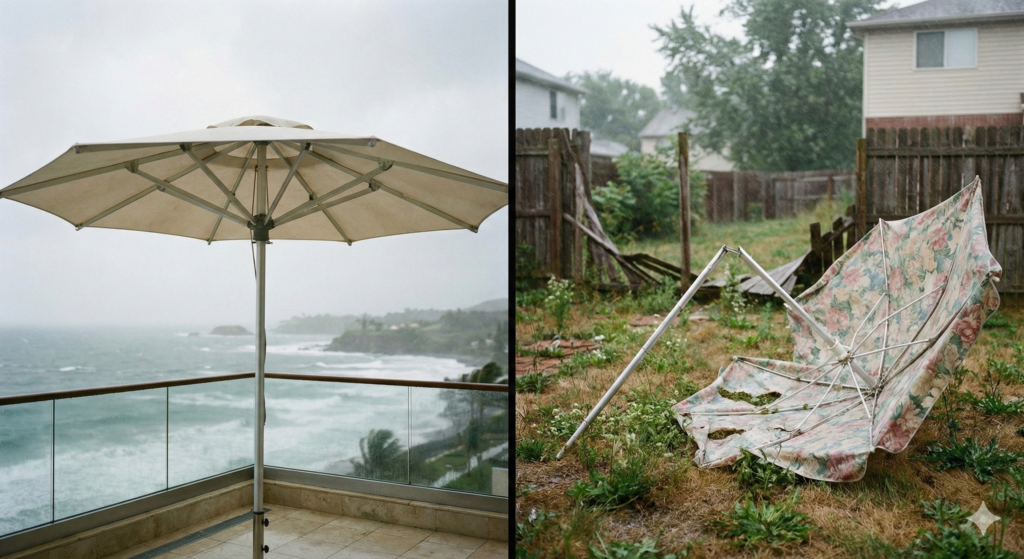
1. Material Science: The Engineering Disconnect
When comparing commercial vs residential umbrellas, the most significant differences lie hidden within the physical properties of their materials. Let us examine the three vital components: the central pole, the rib assembly, and the canopy fabric.
The Center Pole: Wall Thickness is Everything
The pole acts as the spine of the shade structure.
-
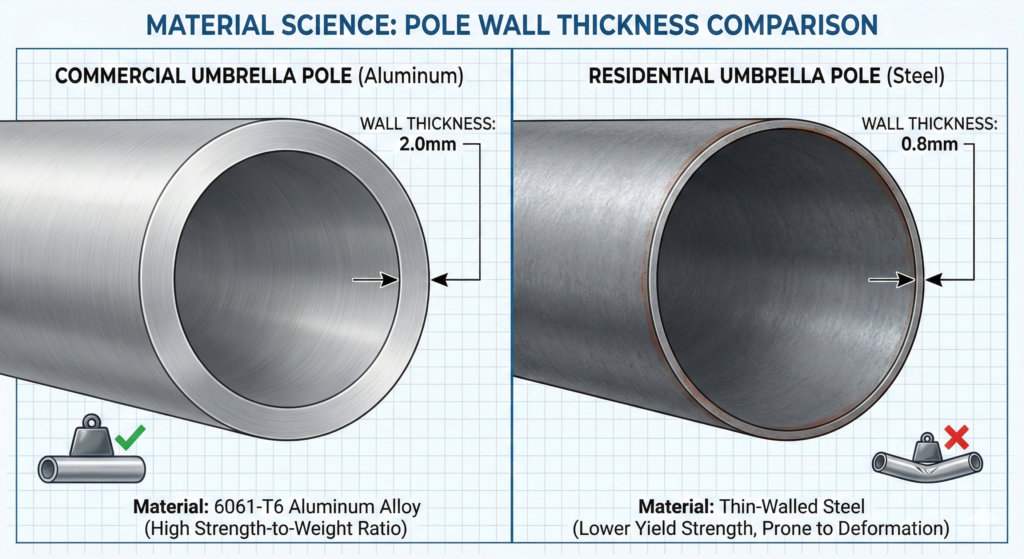
Residential Poles: Typically constructed from thin-walled steel or light aluminum. The wall thickness is usually between 0.8mm and 1.2mm. While sufficient for a gentle backyard breeze, these thin walls will easily crimp, bend, or snap under commercial use. Furthermore, steel poles will eventually rust, staining expensive patio tiles.
-
Commercial Poles: Manufactured using heavy-gauge, extruded aluminum (often 6063-T5 grade) or marine-grade fiberglass. A true commercial aluminum pole features a wall thickness of 2.0mm to 3.0mm+ and a larger diameter (1.5 to 2.5 inches). This massive increase in material density provides the tensile strength needed to resist severe lateral wind forces without permanent deformation.
The Ribs: Rigidity vs. Flexibility
The ribs must absorb the upward lift generated when wind catches the canopy.
-
Residential Ribs: Rely on hollow aluminum tubes or thin steel wires. These materials are rigid but brittle. When wind force exceeds their limits, they break permanently, rendering the umbrella useless.
-
Commercial Ribs: High-end commercial designs increasingly favor solid fiberglass ribs created through a specialized pultrusion process. Fiberglass possesses incredible “memory.” During a severe wind gust, a fiberglass rib can bend dramatically to spill the wind and then instantly return to its original straight shape without suffering structural fatigue.
The Canopy: Solution-Dyed vs. Piece-Dyed
Canopy degradation accounts for the vast majority of umbrella failures in the hospitality sector.
-
Standard Polyester (Residential): Uses a piece-dyed method where the color is only applied to the surface of the thread (like a radish). UV rays quickly penetrate this thin layer, leading to fading, rotting, and tearing within 6 to 12 months of constant sun exposure.
-
Solution-Dyed Acrylic / Olefin (Commercial): In solution-dyed fabrics (such as Sunbrella®), the color pigment is infused into the liquid polymer before the yarn is extruded (like a carrot). The color is consistent all the way through. These fabrics meet ASTM G53-96 standards for UV resistance, guaranteeing thousands of hours of vibrant color life, even in harsh climates.
2. Wind Safety Standards (ASTM F3512-21) and Liability
In the B2B sector, safety is not optional. An airborne shade structure is a severe legal liability. The starkest contrast between commercial vs residential umbrellas is how they handle wind.
In 2021, the outdoor furniture industry adopted ASTM F3512-21: Standard Test Method for Evaluating Wind Safety and Durability of Market Umbrellas. Reputable commercial manufacturers engineer their products to pass these stringent wind-tunnel tests, which include:
-
Procedure A (Maximum Wind Strength): Testing the structure against escalating, uniform wind speeds to determine the exact failure point (often exceeding 50-70 mph depending on the model and base).
-
Procedure B (Sustained Wind Durability): Subjecting the open umbrella to a continuous 30-minute high-wind simulation to ensure no joints, ribs, or fabrics suffer fatigue damage over time.
Residential umbrellas bypass this costly testing phase, leaving commercial buyers blind to their actual wind tolerance.
The Venturi Effect Warning
Procurement officers outfitting hotel balconies must be especially cautious. High-rise buildings create the Venturi Effect, a phenomenon where wind is squeezed between structures, accelerating its speed. A manageable 15 mph ground breeze can easily become a 30 mph gust on a 5th-floor balcony. Deploying a residential umbrella in this environment is incredibly dangerous. Commercial balcony umbrellas require reinforced fiberglass ribs and specialized heavyweight bases to survive this aerodynamic challenge.
3. The 5-Year Total Cost of Ownership (TCO) Analysis
Purchasing agents often suffer from “sticker shock” when comparing the upfront costs. However, a 5-year Total Cost of Ownership (TCO) analysis reveals the true financial picture.
-
The Residential Trap: Buying a $100 residential umbrella for a cafe might seem economical. However, due to daily wear, mechanical failure, and UV fading, it will likely need replacement twice a year. Over 5 years (10 replacements), the true cost becomes $1,000 per unit, not including the labor of constantly ordering and assembling new units, or the negative impact on brand image.
-
The Commercial Investment: A $400 commercial umbrella built with extruded aluminum, fiberglass ribs, and solution-dyed acrylic will comfortably last 5 years with minimal maintenance. The TCO remains $400. You save $600 per unit while elevating your property’s aesthetic and safety profile.
4. Head-to-Head Specification Comparison
Use this quick-reference table to guide your procurement team when evaluating supplier catalogs:
| Specification | Commercial Grade | Residential Grade |
| Ideal Environment | Resorts, Restaurants, Parks | Private Backyards, Seasonal Patios |
| Pole Aluminum Thickness | 2.0mm – 3.0mm+ (Heavy-duty) | 0.8mm – 1.2mm (Thin-wall) |
| Rib Construction | Solid Fiberglass or Thick Aluminum | Hollow Steel / Thin Aluminum |
| Fabric Technology | Solution-Dyed Acrylic / Commercial Olefin | Standard Piece-Dyed Polyester |
| Opening Mechanism | Marine-Grade Pulley & Pin (Durable) | Crank & Tilt (Prone to breaking) |
| UV Resistance Standard | Meets ASTM G53-96 (1000+ Hours) | Minimal UV Treatment |
| Wind Safety Standard | Tested to ASTM F3512-21 | Rarely Tested |
5. Future-Proofing: 2026 Color and Design Trends
As you source for the upcoming seasons, incorporating current design trends is vital. Authoritative 2026 forecasts from WGSN and Pantone highlight a shift towards grounding, nature-inspired palettes that promote wellness and calm.
When selecting commercial canopies, look beyond standard beige. The defining colors for 2026 include “Transformative Teal”, earthy Sage Green, and warm Terracotta. Because true commercial umbrellas utilize solution-dyed fabrics, you can confidently invest in these rich, vibrant 2026 trend colors knowing they will not fade or bleach out after a single summer.
Conclusion: Partner with a Source Factory You Can Trust
The gap between commercial vs residential umbrellas is vast, impacting everything from guest safety to long-term profitability. B2B buyers must prioritize heavy-gauge materials, structural simplicity, and standardized safety testing over initial aesthetic appeal.
IgerEnjoy is a leading source factory specializing in the rigorous engineering of B2B shade solutions. We maintain complete control over our manufacturing process—from the precise extrusion of our 2.0mm+ aluminum poles to the stitching of our fade-resistant, solution-dyed canopies. Every product we manufacture is built to withstand the punishing demands of the global hospitality industry.
Ready to upgrade your outdoor procurement strategy and lower your long-term replacement costs? Contact the IgerEnjoy B2B team today to request material samples and discuss customized commercial manufacturing for your next project.
FAQ Schema Content:
Q: What is the main difference between commercial vs residential umbrellas?
A: The main difference is material engineering. Commercial umbrellas use heavy-duty materials like 2.0mm+ thick extruded aluminum poles, flexible fiberglass ribs, and solution-dyed acrylic fabrics designed for daily use and high winds. Residential umbrellas use much thinner metals and standard polyester, suitable only for occasional, gentle backyard use.
Q: Are commercial umbrellas tested for wind safety?
A: Yes, high-quality commercial umbrellas are rigorously tested against standards like ASTM F3512-21. These wind-tunnel tests evaluate both the maximum structural strength and sustained wind durability to ensure the umbrellas are safe for public, high-traffic environments.
Q: Why do residential umbrellas fade faster than commercial ones?
A: Residential umbrellas typically use piece-dyed polyester, where the color only coats the outside of the fiber. Commercial umbrellas use solution-dyed fabrics (like acrylic or high-grade olefin), where the color pigment is mixed completely through the fiber, providing thousands of hours of UV resistance without fading.