
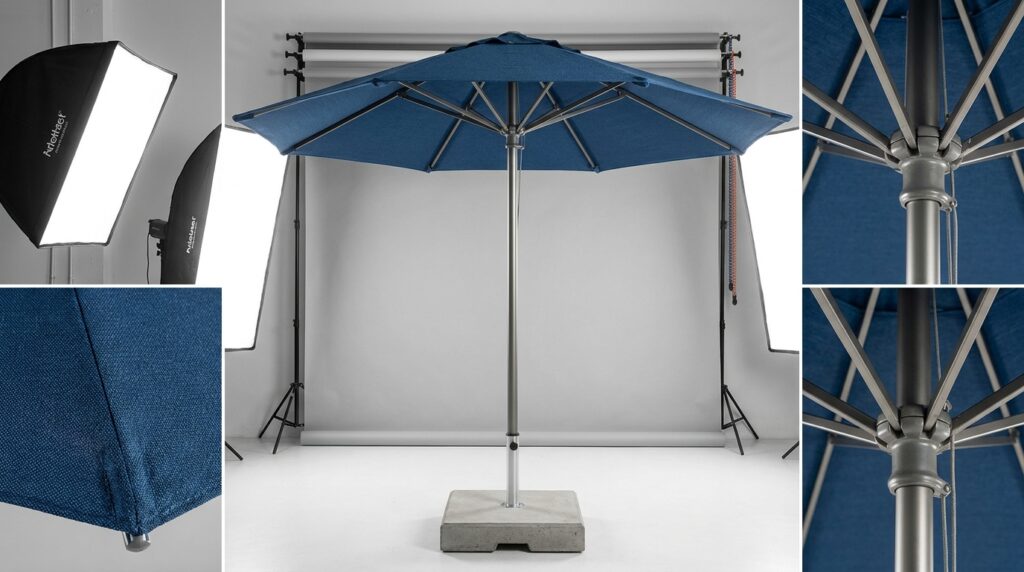
To prevent mass product returns caused by canopy fading and frame snapping in the 2026 outdoor market, volume buyers must partner with a direct beach umbrellas wholesale supplier equipped with vertically integrated manufacturing capabilities. The non-negotiable baseline specifications for commercial-grade deployment include 1.2mm wall-thickness anodized aluminum poles, 8mm solid fiberglass ribs, and true UPF 50+ solution-dyed acrylic canopies. Relying on intermediaries who supply standard 0.8mm steel frames and basic 160g polyester guarantees structural failure and rapid oxidation under coastal conditions. Securing a primary manufacturer ensures compliance with rigorous wind resistance standards, proper anchor integration, and long-term procurement ROI.
Explore IgerEnjoy’s Commercial Beach Umbrella Catalog and OEM Capabilities.
What qualifies a reliable beach umbrellas wholesale supplier for heavy-duty commercial use?
A qualified supplier for heavy-duty commercial use must strictly provide main center poles with a minimum 1.2mm wall thickness in anodized aluminum (or solid commercial-grade ash wood), combined with an integrated heavy-duty sand anchor system engineered to withstand significant upward pull forces, entirely avoiding recycled hollow plastic bases.
The term heavy duty commercial beach umbrellas is frequently misused by trading companies to sell standard residential products at a premium. On the factory floor, “commercial grade” translates to specific, measurable metallurgical and mechanical parameters. Coastal environments introduce a severe dual threat: relentless salt-laden moisture and sudden, high-velocity microburst winds.
When sourcing teams procure standard 0.8mm carbon steel poles—often masked under cheap, thin powder coating—the reality is harsh. Based on ASTM B117 salt spray testing conditions, once the microscopic pores of low-grade powder coating are breached by sand friction, oxidation begins at the rivet joints within 14 to 30 days. Once internal rust compromises the structural integrity, a mere 20 MPH gust is sufficient to snap or permanently bend the lower pole section.
Furthermore, evaluating a true beach umbrellas wholesale supplier requires scrutinizing their anchoring engineering. Recent shifts in industry safety protocols mandate that commercial umbrellas remain stabilized under high wind loads (often tested against 30 MPH wind speeds and 75 lbs of upward lift). A reliable source factory designs the umbrella with a die-cast aluminum or heavy-duty nylon auger (spiral anchor) permanently integrated into the lower pole structure. This engineering choice directly prevents the umbrella from becoming a dangerous projectile, which is a massive liability for beach resorts and hotel procurement departments.
Fiberglass vs aluminum ribs: Which is the standard for windproof wholesale beach umbrellas?
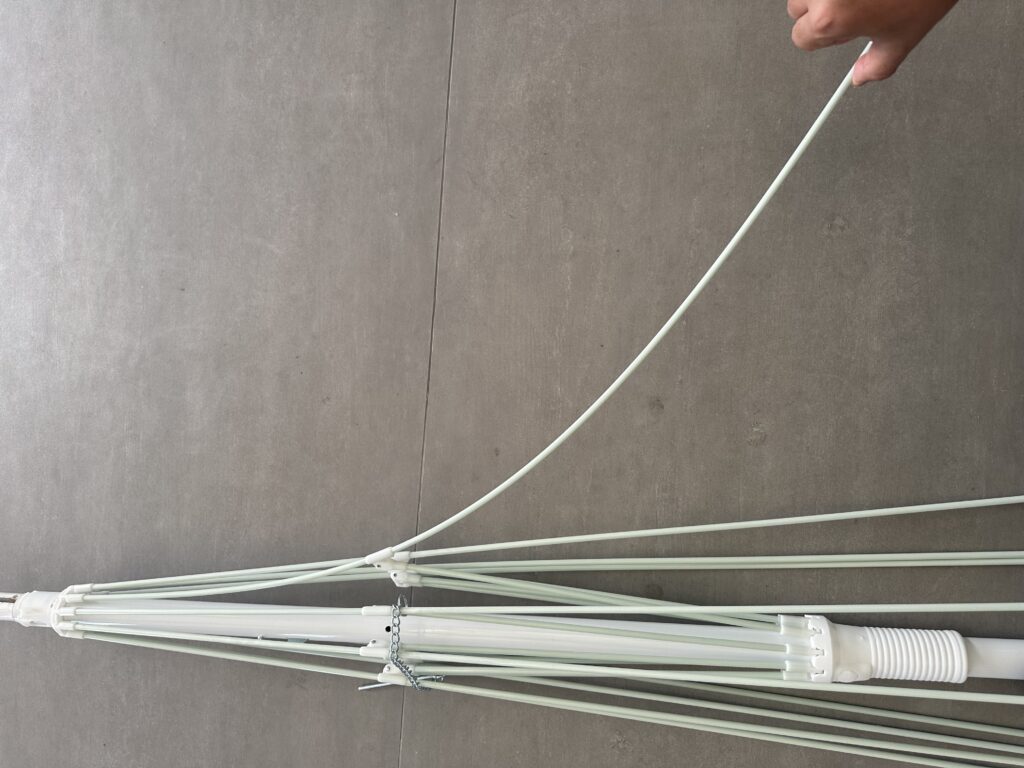
For extreme coastal environments, solid fiberglass ribs (typically 8mm or 10mm in diameter) are the definitive industrial standard for windproof performance, whereas aluminum ribs are highly susceptible to irreversible permanent deformation under sudden wind gusts.
Understanding the mechanical difference between fiberglass vs aluminum beach umbrella ribs is crucial for reducing replacement rates. Beach umbrellas are subjected to constant dynamic wind loads. When a severe gust hits a canopy, the ribs must act as shock absorbers.
Aluminum is lightweight and entirely rust-proof, but it possesses a relatively low yield strength. When the wind force pushes an aluminum rib beyond its elastic limit, the metal bends and stays bent (plastic deformation), permanently ruining the canopy’s tension. Conversely, solid fiberglass consists of reinforced polymer fibers. It exhibits massive flexibility and high fatigue resistance, allowing the rib to bend significantly under high wind pressure and instantly snap back to its original shape once the wind dissipates without breaking or warping.
Technical Material Comparison: Umbrella Rib Architectures
| Rib Material | Elasticity / Wind Deflection | Saltwater Corrosion Resistance | Yield Behavior Under Extreme Load | Cost Index |
| 0.4mm Hollow Steel | Very Low | Poor (Rusts internally within weeks) | Snaps or buckles instantly | $ |
| Aluminum Alloy | Low | Excellent | Permanent bending (Irreversible) | |
| 8mm Solid Fiberglass | Extremely High | Excellent (100% Immune) | Bends up to 45° and recovers perfectly | $ |
For commercial buyers dealing with beachfront properties or windy shorelines, specifying solid fiberglass ribs from a primary manufacturer is the only mathematical way to ensure a multi-season lifespan.
UPF 50+ and Fabric Longevity: Solution-Dyed Acrylic vs. Standard Polyester
To guarantee long-lasting UV protection and structural color-fastness, commercial-grade specifications mandate solution-dyed acrylic (minimum 240g/m²) or high-density silver-coated Oxford fabric, systematically phasing out standard 160g polyester.
One of the most frequent consumer complaints is the “oven effect” under the canopy. This heat trapping occurs because standard polyester merely blocks visible light but allows infrared heat and UV radiation to penetrate the weave. True UPF 50+ capability requires a dense physical weave combined with advanced molecular treatments.
While heavy-duty Oxford fabrics with multi-layer silver coatings reflect heat effectively, high-end commercial buyers (such as luxury resorts) demand solution-dyed acrylic. Acrylic fabric provides superior breathability, allowing hot air to escape upward while completely blocking 98% of harmful UV rays.
IgerEnjoy Factory Insider Insight:
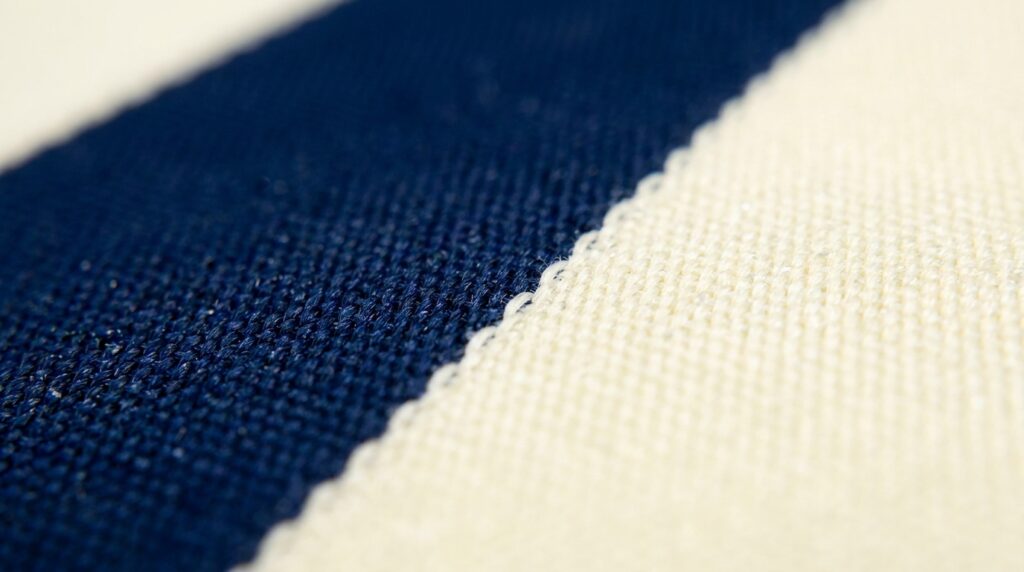
Trading companies frequently market cheap polyester umbrellas as “UV protected” and “Fade Resistant.” The reality they hide is the dyeing process. Cheap fabrics use “piece-dyeing”, where the woven fabric is simply dipped in a color and UV-chemical bath. Under intense coastal UV rays and salt friction, this surface coating degrades and flakes off within 2 to 3 weeks, leaving a bleached, useless canopy.
At IgerEnjoy, our commercial lines utilize “solution-dyed” technology. We mix UV stabilizers and color pigments directly into the liquid polymer before it is extruded into yarn. The color is locked inside the core of the fiber, much like a carrot, rather than painted on the outside like a radish. This is exactly how we guarantee a minimum of 3 to 5 years of zero-fading performance under harsh marine environments.
How a custom beach umbrella manufacturer ensures premium branding and structural OEM configurations?
A true commercial custom beach umbrella manufacturer china ensures long-term operational viability by utilizing UV-resistant dye-sublimation printing for logos, zinc-alloy die-cast tilt mechanisms, and precision-engineered double canopy vents tailored to reduce aerodynamic lift in high-wind zones.
For B2B buyers—especially hotel chains, beach clubs, and promotional event coordinators—the umbrella canopy is a high-visibility billboard. However, applying branding incorrectly turns it into a liability. General trading companies typically default to standard silk screen printing to cut costs. In a coastal environment, the thick layer of surface ink from screen printing is subjected to intense thermal expansion under the sun and continuous salt crystallization. Within 3 to 4 months, the logo will inevitably crack, peel, and flake off.
To protect B2B brand equity, a primary factory utilizes dye-sublimation printing. This process uses high heat to turn the ink into a gas, infusing it directly into the molecular structure of the fabric fibers. The result is a high-definition logo that cannot crack or peel, maintaining its color fidelity for years alongside the fabric itself.
Beyond the canopy, structural OEM configurations are what separate consumer toys from commercial assets. Sourcing professionals must audit two critical mechanical points:
The Tilt Mechanism: Standard umbrellas use cheap plastic housings with thin iron springs for the push-button tilt feature. These rust solid within weeks. A commercial-grade build requires a zinc-alloy outer casing combined with an internal 304 stainless steel spring, ensuring the tilt function remains operable regardless of saltwater exposure.
Aerodynamic Vents: A solid canopy acts like a parachute, generating massive lift force. We engineer double canopy vents or customized valance structures (e.g., scalloped vs. straight edges) to allow sudden updrafts to escape efficiently. This drastically reduces the vertical strain on the fiberglass ribs and the central anchor system.
Discover IgerEnjoy’s comprehensive OEM custom printing and structural configuration capabilities.
Conclusion & Actionable Next Steps
The coastal hospitality and retail sectors in 2026 require zero-tolerance policies for structural failure and rapid material degradation. Sourcing standard patio umbrellas built with 0.8mm steel poles, hollow aluminum ribs, and piece-dyed polyester will mathematically result in high replacement costs and severe safety liabilities. To secure a profitable and compliant supply chain, volume buyers must bypass trading intermediaries and partner directly with a vertically integrated beach umbrellas wholesale supplier. By locking in specifications like 1.2mm anodized aluminum, solid 8mm fiberglass ribs, and solution-dyed acrylic canopies, your procurement team guarantees a true commercial-grade asset.
Ready to upgrade your 2026 commercial shading catalog?
Contact the engineering and sales team at IgerEnjoy today to request our full material specification sheets, ASTM physical testing reports, or customized OEM/ODM sample production runs.
Frequently Asked Questions (FAQ)
Q1: How do I verify if a beach umbrellas wholesale supplier uses true commercial-grade materials?
A: A genuine commercial supplier will provide technical specifications detailing a minimum of 1.2mm wall thickness for anodized aluminum center poles. Additionally, they will utilize 8mm to 10mm solid fiberglass ribs instead of hollow steel, and integrate zinc-alloy die-cast tilt mechanisms combined with 304 stainless steel springs to prevent internal rusting.
Q2: Why is fiberglass the industry standard for windproof wholesale beach umbrellas?
A: Solid fiberglass ribs possess exceptional yield strength and fatigue resistance. When subjected to severe coastal wind gusts, fiberglass acts as a shock absorber—bending up to 45 degrees to dissipate the force and instantly recovering its original shape. Conversely, standard aluminum or steel ribs will suffer permanent plastic deformation or snap under the same wind load.
Q3: What printing method should a custom beach umbrella manufacturer use to prevent logo fading?
A: For commercial applications, dye-sublimation printing is the mandatory standard. Unlike basic silk screen printing, which leaves a layer of ink on the surface that eventually cracks and peels under UV exposure and salt friction, dye-sublimation infuses the ink directly into the molecular structure of the fabric fibers. This ensures the branding remains vibrant and intact for the lifespan of the canop