
Direct Answer for Sourcing Managers: Sustainable commercial outdoor shade requires balancing material circularity, non-toxic chemistry, and marine-grade longevity. Specifying GRS-certified rPET (Recycled Polyethylene Terephthalate) fabrics combined with PFC-Free (fluorine-free) hydrophobic finishes reduces product carbon footprints by up to 52% while eliminating toxic PFAS chemicals. When paired with high-strength architectural aluminum engineered with thermal-transfer wood finishes, eco-friendly umbrellas deliver identical UPF 50+ sun protection, Grade 5–6 lightfastness, and wind stability compared to virgin synthetic structures.
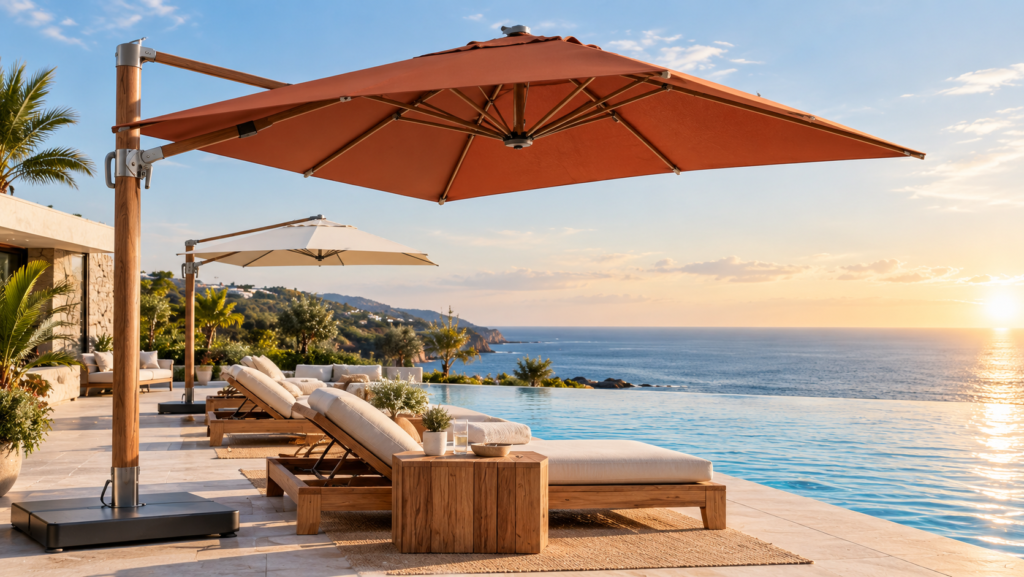
1. The ESG Mandate: Why Green Procurement Governs Hospitality Projects
In commercial hospitality design—spanning luxury beachfront resorts, urban rooftop dining, and public commercial plazas—sustainability has transitioned from a marketing buzzword into an enforceable procurement mandate.
Major multinational hospitality developers and corporate procurement departments now enforce stringent Environmental, Social, and Governance (ESG) scorecards across their exterior furniture tenders. Specifying standard virgin synthetic textiles treated with legacy fluorinated chemicals increasingly triggers non-compliance flags during environmental audits.
Achieving a sustainable exterior footprint requires sourcing directors to evaluate three core engineering criteria:
Circular Feedstocks: Utilizing post-consumer or post-industrial recycled fibers verified by independent chain-of-custody standards.
Clean Chemistry Compliance: Eliminating bioaccumulative per- and polyfluoroalkyl substances (PFAS) in durable water-repellent (DWR) surface coatings.
Extended Lifecycle Engineering: Ensuring that eco-friendly materials do not compromise tear strength, UV resistance, or multi-year commercial outdoor lifespans.
2. Technical & Environmental Comparison: Outdoor Umbrella Textiles
The table below compares technical performance, ecological metrics, and regulatory compliance across the primary commercial canopy materials:
| Engineering Parameter | Virgin Piece-Dyed Polyester | Solution-Dyed Polyester (SDP) | GRS-Certified rPET Recycled Fabric | Solution-Dyed Olefin (Polypropylene) | Solution-Dyed Acrylic (Sunbrella Grade) |
| Raw Material Feedstock | 100% Virgin Petroleum | Virgin Polymer + Pigments | 100% Post-Consumer Plastic Bottles | Recycled / Virgin Polyolefin | Virgin Acrylonitrile |
| Carbon Footprint Reduction | Baseline (0% Reduction) | ~15% Reduction (Zero Dye Bath) | 45% to 55% CO2e Reduction | ~35% Reduction (Low melt energy) | ~10% Reduction |
| Water Consumption in Dyeing | High (Traditional liquid dyeing) | Minimal (Integrated in melt) | Near-Zero (Spin-dye technology) | Zero (Dry extrusion) | Near-Zero |
| Color Fastness to Light (AATCC 16E) | Grade 3.5–4.0 (~400 UV hours) | Grade 5.0–6.0 (~1,000 UV hours) | Grade 5.0–6.0 (~1,000 UV hours) | Grade 7.0–8.0 (~2,000+ UV hours) | Grade 7.0–8.0 (~2,000+ UV hours) |
| UV Protection Rating | UPF 30+ to 50+ (Coating reliant) | UPF 50+ (Excellent Protection) | Certified UPF 50+ (Blocking 98% UV) | UPF 50+ (Natural high block) | UPF 50+ |
| Chemical Safety Compliance | Often contains legacy PFCs | Variable by supplier | 100% OEKO-TEX 100 & PFC-Free | Naturally chemical inert | Standard fluorocarbon finish |
| Cost Index (Relative Benchmark) | 1.0 (Baseline) | 1.35x – 1.50x | 1.40x – 1.60x | 1.75x – 2.10x | 2.50x – 3.20x |
| Target ESG Application | Promotional events, retail | Mainstream residential, cafes | Hospitality tenders, LEED/ESG projects | High-UV resorts, desert climates | Luxury mega-yachts, ultra-luxury |
3. Engineering Sustainable Textiles: From Discarded Bottles to Commercial Shade
Rather than relying on virgin petrochemical synthesis, our certified rPET production workflow follows a strictly documented circular manufacturing model:
The rPET Circular Production Cycle
Feedstock Collection & Mechanical Sorting
Post-consumer PET beverage containers collected from verified coastal and municipal recycling streams
Thorough optical sorting, cap/label removal, and continuous hot-water decontamination
Flake Granulation & Polymer Extrusion
Washed PET flakes melted and filtered into high-purity recycled polyester polymer pellets
Molten polymer combined with color pigments during extrusion (solution-dyeing) to eliminate wet-bath chemical effluent
High-Tenacity Yarn Spinning & Weaving
Extruded filaments spun into high-tensile yarns engineered for outdoor tensile stress
Tight canvas plain-weave construction (220–280 gsm) delivering superior dimensional stability and wind resistance
Environmental Impact by the Numbers
Plastic Diversion: A single 3.0m commercial patio umbrella canopy diverts approximately 48 to 55 discarded 500ml plastic bottles from landfills and marine ecosystems.
Energy Savings: Manufacturing mechanical rPET fibers consumes up to 59% less electrical energy compared to extracting and refining virgin petroleum polyester feedstocks.
Traceable Chain of Custody: Every commercial production run is certified through Global Recycled Standard (GRS) transaction certificates, providing audited documentation for client ESG annual reports.
4. Green Chemistry: Transitioning to PFC-Free Water Repellency
The outdoor textile industry is undergoing a mandatory regulatory revolution regarding Durable Water Repellent (DWR) surface finishes.
Under the European Union’s REACH regulatory framework and legislative bans passed across several US states (including California, New York, and Minnesota), textiles containing long-chain (C8) and short-chain (C6) per- and polyfluoroalkyl substances (PFAS) are banned from commercial distribution.
At Igerenjoy, our outdoor textiles utilize advanced PFC-Free (Fluorine-Free) Biomimetic DWR Technology:
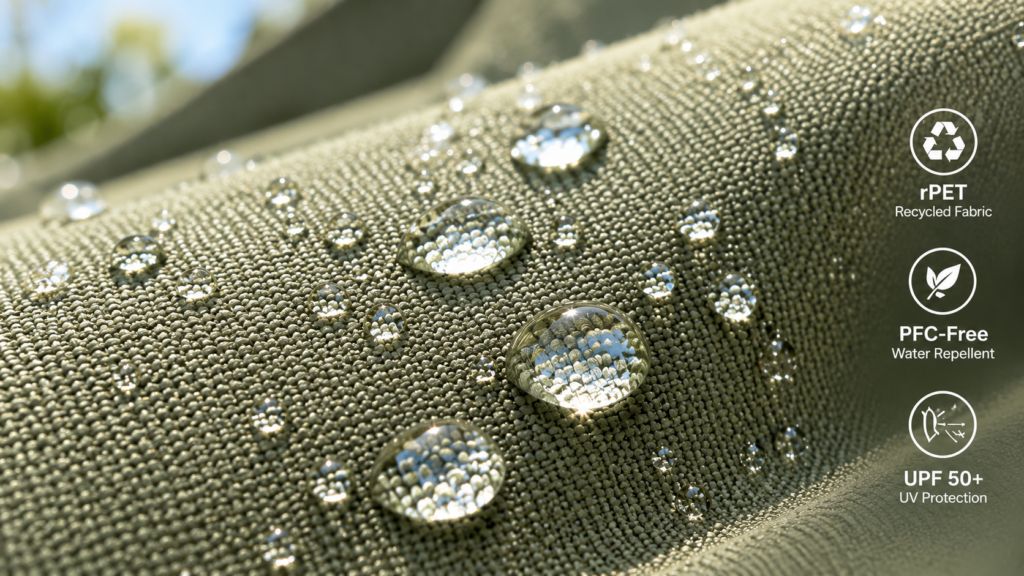
The Biomimetic Lotus Leaf Effect: Our specialized non-fluorinated silicone and hydrocarbon-based emulsions lower the surface energy of individual fibers. Water and organic liquids cannot wet the fabric; instead, surface tension forces droplets to bead into tight spheres (>120° contact angle) that roll off instantly.
Hydrostatic Head Performance: Delivers water column resistance exceeding 800mm to 1,000mm, allowing canopies to shed sudden summer cloudbursts while preserving natural fabric breathability.
Human Ecological Safety: Fully compliant with OEKO-TEX Standard 100 (Class I/II), certifying that canopies emit zero formaldehyde, phthalates, heavy metals, or volatile organic compounds (VOCs) under intense direct solar heat.
5. Timber Conservation: Wood-Grain Aluminum vs. Natural Hardwoods
Sustainable outdoor architecture requires examining frame hardware alongside canopy textiles. While natural teak, eucalyptus, and ash poles offer traditional visual warmth, commercial reality presents significant environmental and operational trade-offs:
Environmental Trade-Offs of Solid Wood
Deforestation pressures on slow-growing tropical timber species.
High annual chemical maintenance requirements (solvents, toxic chemical sealers, and teak oils applied repeatedly).
High organic failure rates: moisture absorption leads to internal swelling, runner-binding, surface mold, and structural splitting under wind stress.
The Engineered Sustainable Alternative: Wood-Grain 6063-T6 Aluminum
100% Recyclable Alloy Core: Architectural-grade 6063-T6 aluminum alloy possesses indefinite recyclability without loss of mechanical yield strength.
Zero Chemical Maintenance: Immune to rot, fungal mold, termite infestation, and marine salt corrosion. Completely eliminates the recurring labor and chemical footprint of annual wood treatment.
High-Definition Vacuum Transfer: Vacuum thermal-transfer technology infuses realistic, matte wood-grain patterns deep into a specialized polyurethane powder basecoat, delivering the organic aesthetic of natural timber with the unyielding strength of metal.
6. Frequently Asked Questions (FAQ)
Q1: Does recycled rPET fabric fade faster than virgin polyester outdoors?
A: No. Fade resistance is determined by the dyeing method and UV stabilizer formulation, not whether the polyester polymer originated from a petroleum well or a recycled bottle. Because our rPET fabrics incorporate solution-dyeing (pigments infused directly into the liquid polymer core), they achieve Grade 5–6 lightfastness (1,000+ direct UV hours), matching or exceeding virgin piece-dyed fabrics.
Q2: What certifications should buyers look for to verify sustainable outdoor umbrellas?
A: Commercial procurement managers should require three independent third-party certifications:
Global Recycled Standard (GRS): Verifies recycled content percentage and social/environmental manufacturing practices.
OEKO-TEX Standard 100: Guarantees raw materials and finishes are free from harmful toxic substances.
PFC-Free / Zero-PFAS Laboratory Reports: Confirms that durable water repellency was achieved without fluorinated chemical compounds.
Q3: How do sustainable umbrellas contribute to LEED or BREEAM building credits?
A: For commercial hospitality developments seeking green building certification (such as LEED BD+C or BREEAM International), outfitting exterior terraces with certified rPET and recyclable aluminum shade structures contributes toward points in Materials and Resources (MR) credits—specifically under Building Product Disclosure and Optimization (Environmental Product Declarations and Sourcing of Raw Materials).
Q4: What is the minimum order quantity (MOQ) for custom-colored rPET canopies?
A: For standard sustainable color palettes (Terracotta, Olive Green, Natural Sand, Navy, and Charcoal), our MOQ starts at 100 units. For fully custom Pantone-matched yarn extrusion in rPET, typical minimum production batches start at 300 to 500 units depending on umbrella diameter and frame complexity.
7. Summary: Future-Proof Your Brand with Sustainable Outdoor Shade
Meeting modern commercial procurement criteria requires an OEM manufacturing partner who integrates circular materials, clean chemical safety, and durable structural engineering into every stage of production.
At Igerenjoy (Shaoxing Yige Leisure Products Co., Ltd.), we lead the transition toward responsible outdoor living. We engineer and export complete certified eco-shade collections—from vintage fringe beach umbrellas made with recycled rPET to heavy-duty 3.5m cantilever systems equipped with wood-grain aluminum and solar LED lighting.
Ready to specify certified sustainable shade structures for your upcoming commercial tender?
Contact our export engineering team today to receive physical rPET fabric swatch cards, GRS certification documentation, and competitive FOB Ningbo/Shanghai quotation sheets.