
Executive Summary
For FMCG (Fast-Moving Consumer Goods), breweries, and corporate beverage brands, procuring promotional patio umbrellas is a strict exercise in brand identity execution and structural survival. A reliable custom promotional patio umbrella manufacturer must deliver 100% Pantone color accuracy and permanent UV-resistant printing (utilizing rotary dye-sublimation or baked screen printing) to prevent logo peeling. Structurally, the umbrella must feature a minimum 1.0mm to 1.2mm aluminum frame and a size-appropriate lift system—balancing convenient crank handles for small models with fail-proof pulley and pin-lock systems for oversized canopies.
Procuring cheap promotional giveaways from generic middlemen guarantees peeling logos, faded canopies, and snapped internal crank ropes—actively destroying brand equity and creating physical liabilities in public dining spaces. Sourcing directly from a vertically integrated factory ensures that your physical brand assets survive multiple high-traffic seasons without structural failure.
Explore IgerEnjoy’s Custom Promotional Umbrella Manufacturing Capabilities.
Color is King: Achieving 100% Pantone Accuracy for Corporate Identity
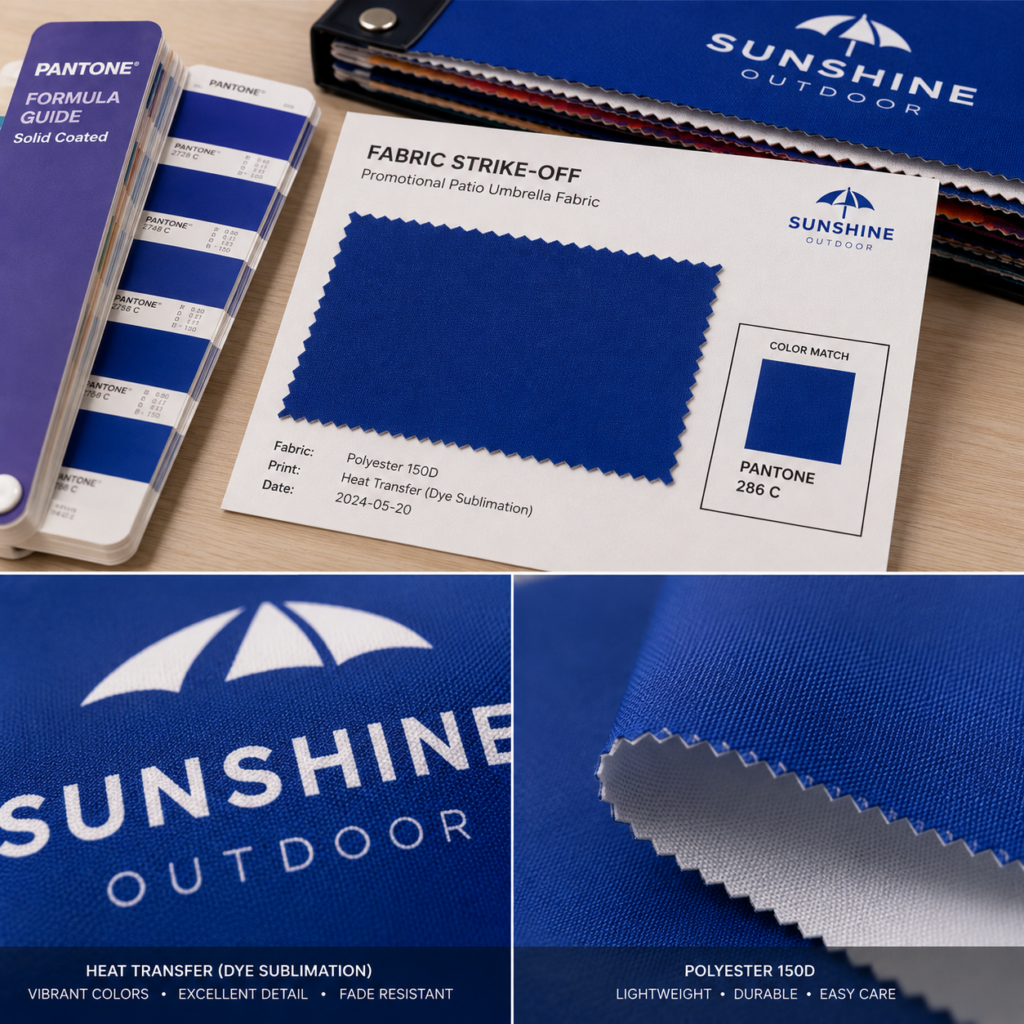
To achieve strict global corporate color standards (such as Heineken Green or Coca-Cola Red), a factory cannot rely on visual ink mixing by floor workers. Precision manufacturing requires calibrated spectrophotometers and the Pantone Matching System (PMS), strictly validated by physical fabric strike-offs prior to any mass production.
For global beverage brands, color consistency is a non-negotiable standard. A frequent supply chain failure occurs when trading companies source pre-dyed stock fabric from open textile markets, resulting in “close enough” colors. When a brand’s umbrella is set up next to its official printed product packaging on a patio table, any hue shift makes the premium brand appear like a cheap counterfeit. Furthermore, colors behave differently depending on the fabric substrate (e.g., 160g standard polyester vs. heavy-duty 600D Oxford).
IgerEnjoy Factory Insider Insight:
A massive trap in promotional umbrella procurement is metamerism. Small workshops often mix screen-printing inks by eye under harsh fluorescent factory lighting. It might look correct on the production line, but once the umbrella is deployed under natural UV sunlight, the color violently shifts, often turning deep corporate blues into purples.
At IgerEnjoy’s printing workshop, we eliminate this risk through our strict “Fabric Strike-off” protocol. We mix inks using digital PMS formulas under D65 standard daylight lamps and print a physical 30cm x 30cm sample on the exact coated fabric substrate being used for the final order. This physical sample is shipped directly to the brand’s procurement director for sign-off, ensuring absolute zero color variance in the final mass run.
Printing Technologies: Dye-Sublimation vs. High-Density Screen Printing
The most frequent point of failure in promotional umbrellas is not the metal frame, but the ink. When standard trading companies process volume orders, they use basic plastisol screen-printing inks to aggressively cut costs. Under the intense UV radiation and thermal fluctuations of an outdoor patio, this surface ink expands and contracts at a different rate than the underlying polyester fabric. Within 30 days, this thermal mismatch causes the logo to crack, peel, and flake off entirely.
To guarantee visual permanence, IgerEnjoy engineers the printing process based on the brand’s specific artwork and deployment environment:
High-Density Screen Printing: If the client requires solid PMS colors, we utilize specialized marine-grade, UV-resistant inks. We strictly control the thermal curing process in our industrial ovens (running at 160°C) to ensure the ink bonds deeply with the fabric weave. This baking process prevents the “flaking” effect associated with cheap, air-dried printing.
Rotary Dye-Sublimation: For full-bleed designs, large background graphics, or complex gradients, we utilize industrial rotary dye-sublimation presses. Operating at 200°C (390°F), this process converts the solid ink directly into a gas, infusing it at a molecular level with the 600D Oxford fibers. The ink literally becomes part of the fabric substrate. It will never crack, peel, or scratch off, guaranteeing a multi-season lifespan.
Canopy Geometry: Square vs. Round Umbrellas for Brand Layout
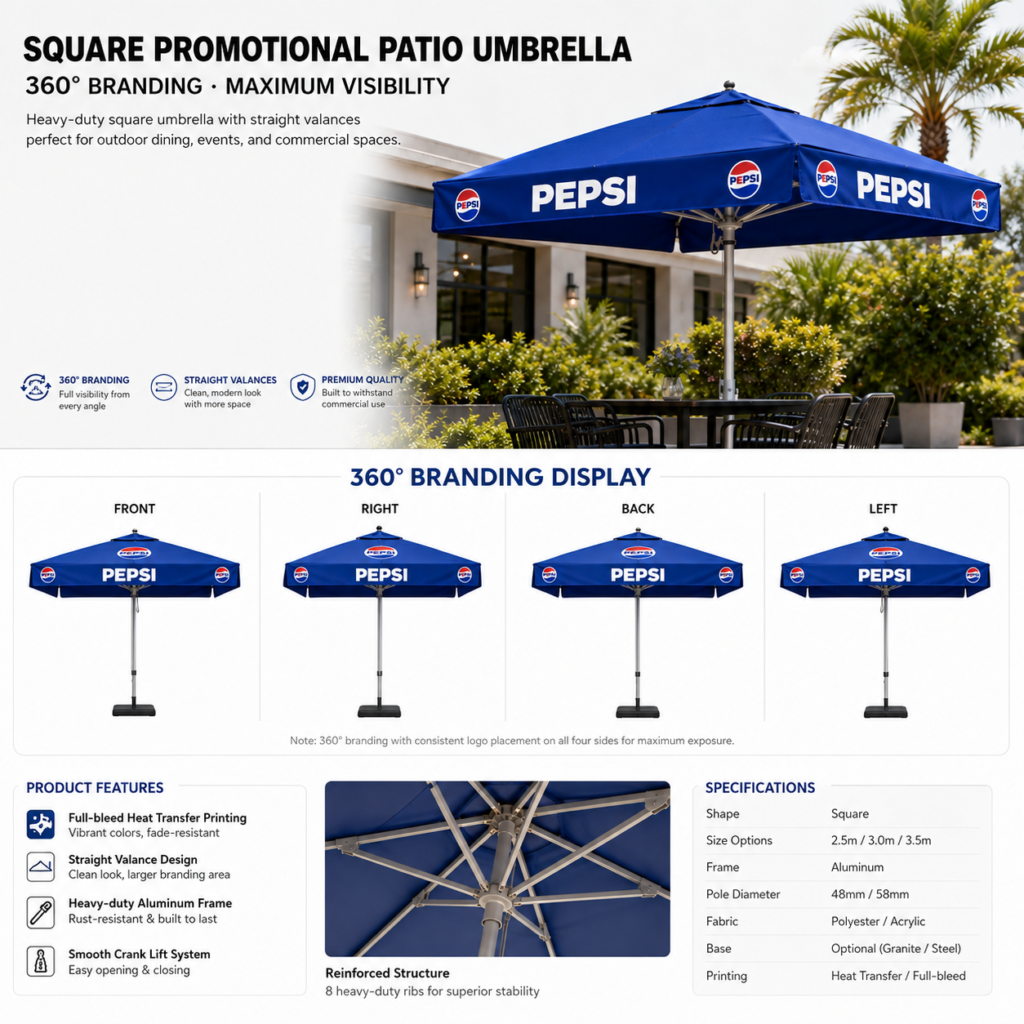
Round (8-panel) umbrellas are the cost-effective standard for symmetrical, center-focused logos, whereas square (4-panel) umbrellas provide a significantly larger flat canvas and longer continuous valances, maximizing horizontal eye-level advertising space.
For advertising agencies, the geometric shape of the umbrella actively dictates the layout of the graphic design. A standard round (octagonal) umbrella divides the canopy into eight narrow triangular panels. If a beverage brand possesses a long, horizontal logo, printing it across the seams of an 8-panel dome results in severe visual distortion.
By dividing a square canopy into four massive panels, it provides a wide, uninterrupted canvas perfect for large-scale branding. Furthermore, square umbrellas present a unique manufacturing challenge: the diagonal ribs reaching the corners are longer than the horizontal ribs reaching the flat sides. This requires highly precise CNC fabric cutting and tension sewing to prevent the canopy from sagging.
When manufactured correctly, the square geometry provides four long, perfectly straight valances (the vertical hanging flaps). These straight valances act as highly readable, 90-degree eye-level banners for printing website URLs or secondary marketing slogans, which is geometrically impossible on a curved round valance.
The Lift System: When to Use Crank Handles vs. Heavy-Duty Pulley & Pin-Locks
One of the most critical decisions in purchasing promotional umbrellas is selecting the correct lift mechanism. A reliable factory does not apply a “one-size-fits-all” approach; the choice between a hand-crank and a pulley system must be dictated by the physical size and weight of the canopy.
Most standard patio umbrellas feature a Crank Lift mechanism. This system houses a small zinc-alloy gear system and a 2mm to 3mm nylon cord inside the center pole.
The Proper Use Case for Cranks: For smaller promotional umbrellas (e.g., 2m to 2.5m / 6.5ft to 8ft round canopies), the hand-crank is an excellent, user-friendly choice. The fabric weight and fabric tension are relatively low, allowing restaurant staff to open the umbrella smoothly without putting excessive strain on the internal gears.
The Failure of Cranks on Oversized Umbrellas: The fatal flaw occurs when trading companies install standard crank systems on large commercial umbrellas (e.g., 3m / 10ft round, or 2.5×2.5m square canopies). The sheer weight of the heavy-duty fabric, combined with the extreme tension required to keep a large canopy taut, places massive strain on the small internal gears. In a busy restaurant, when an untrained staff member forces the crank handle to fully open a heavy umbrella (over-cranking), the gears immediately strip, or the internal cord snaps under the tension. Once the internal cord snaps, the umbrella is permanently ruined.
The Heavy-Duty Solution: Pulley & 304 Stainless Steel Pin-Lock
For oversized promotional umbrellas or ultra-high-traffic commercial deployments, a custom promotional patio umbrella manufacturer must abandon the internal crank and upgrade to a double pulley and pin-lock system.
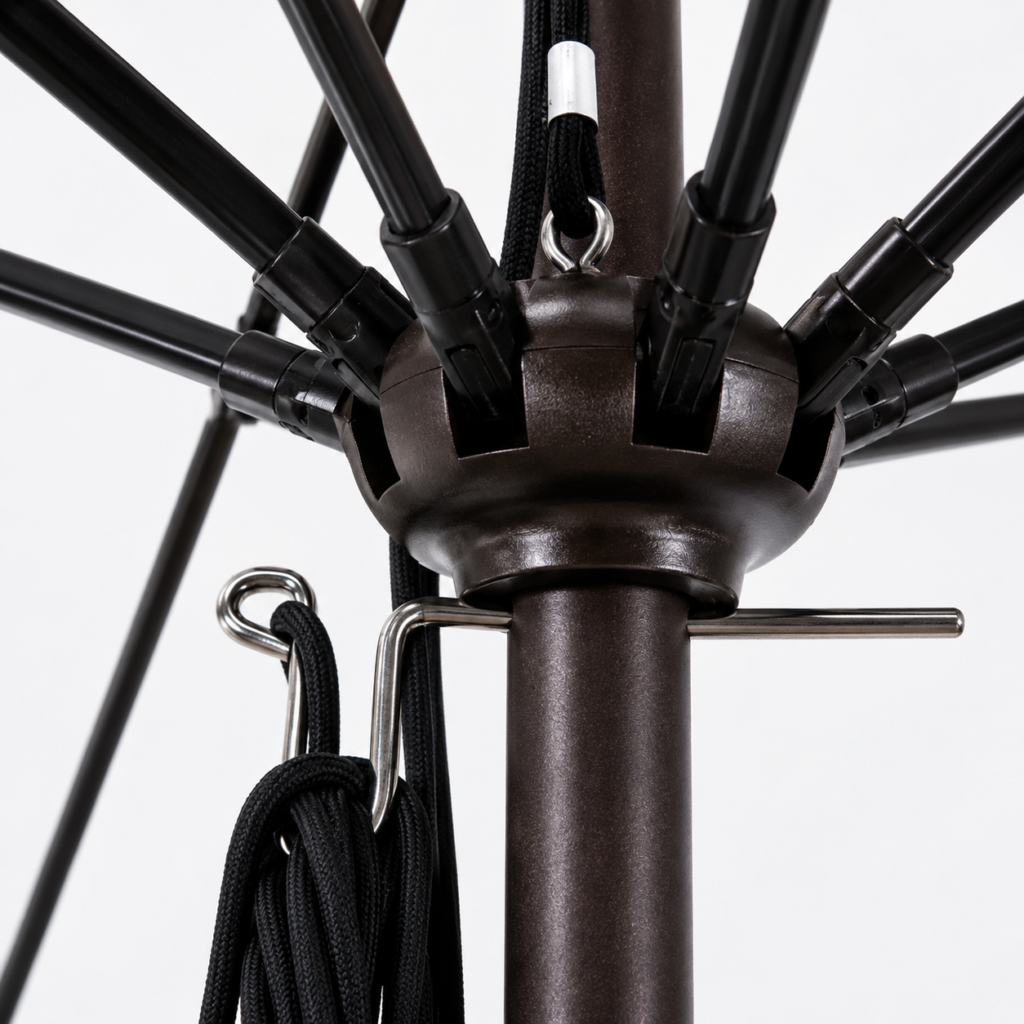
The Double Pulley: We mount a heavy-duty external pulley block at the top of the hub, utilizing thick marine-grade braided rope. The physics of a double-pulley cuts the required lifting effort in half. This allows staff to hoist massive, heavy canopies smoothly without relying on fragile internal gears.
The 304 Stainless Steel Pin-Lock: Once the umbrella is hoisted to the desired height, the user simply inserts a solid 304 stainless steel locking pin directly through pre-drilled holes in the aluminum center pole.
This system contains zero hidden moving parts, no fragile gears to strip, and no crank handles to break off. The entire weight of the commercial canopy is supported by a solid rod of stainless steel. It is virtually indestructible and is the absolute mandatory standard for any branded umbrella deployed in public hospitality sectors.
The Hardware Backbone: 1.2mm Aluminum & Flexible Fiberglass
Because promotional umbrellas are categorized as B2B marketing expenses, procurement teams are frequently pressured to aggressively lower the unit price. However, sourcing a patio umbrella built on a 0.6mm or 0.8mm hollow steel pole is a severe safety liability. If a gust of wind snaps a cheap umbrella pole and injures a restaurant customer, it triggers a massive legal disaster for the sponsoring beverage brand.
A reliable OEM factory protects the brand by enforcing strict structural safety baselines. Even on tight volume budgets, we strictly utilize 1.0mm to 1.2mm wall-thickness aluminum center poles. This thickness ensures absolute structural rigidity at the fulcrum point (where the pole meets the patio table hole) without adding excessive shipping weight.
Furthermore, we integrate flexible 6mm solid fiberglass ribs. Unlike hollow steel ribs that permanently bend under wind pressure, solid fiberglass acts as a mechanical shock absorber. The ribs flex to dissipate dynamic wind shock and instantly return to their straight position. This engineering ensures the physical billboard remains standing safely and aesthetically perfect throughout the entire promotional campaign.
Conclusion & Actionable Next Steps
Treating a branded promotional umbrella as a cheap disposable giveaway guarantees brand degradation through peeling logos, faded colors, stripped crank handles, and broken poles. To protect corporate brand equity, advertising agencies and beverage brands must partner directly with a vertically integrated custom promotional patio umbrella manufacturer.
By securing 100% Pantone color accuracy via physical fabric strike-offs, mandating high-temperature rotary dye-sublimation, specifying the correct lift system based on canopy size, and enforcing a strict 1.2mm structural safety baseline, procurement teams transform a basic shade canopy into a durable, high-retention marketing asset.
Ready to deploy flawless outdoor brand assets?
Contact the OEM engineering and printing team at IgerEnjoy today to request a physical fabric strike-off in your exact corporate Pantone color and detailed frame specifications for your next outdoor promotional campaign.
Frequently Asked Questions (FAQ)
Q1: How does a factory guarantee exact Pantone color matching for promotional umbrellas?
A: Reliable manufacturers utilize calibrated spectrophotometers and the Pantone Matching System (PMS). Before mass production, the factory must provide a “Fabric Strike-off”—a physical 30cm x 30cm printed fabric swatch on the exact material substrate (like 600D Oxford) for the brand’s marketing team to approve under natural D65 daylight, ensuring zero color variance.
Q2: Should I choose a crank lift or a pulley system for a commercial patio umbrella?
A: The choice depends strictly on the umbrella’s size and weight. For smaller promotional umbrellas (under 2.5m / 8ft), a crank lift is highly convenient and operates safely under low fabric tension. However, for oversized commercial umbrellas (3m / 10ft or large squares), the heavy canopy tension will quickly strip internal crank gears. Large umbrellas must use a heavy-duty double pulley system secured with a 304 stainless steel locking pin to eliminate mechanical failure.
Q3: Why do standard screen-printed logos on patio umbrellas crack and peel?
A: Standard trading companies use cheap plastisol inks and rely on rapid air-drying to cut costs. Under intense outdoor UV radiation and thermal fluctuations, this surface ink expands and contracts at a different rate than the underlying polyester fabric, causing the logo to crack and flake off within weeks. For permanent durability, brands should specify thermally-cured (oven-baked at 160°C) marine-grade UV inks or utilize full-bleed rotary dye-sublimation.
Q4: What is the minimum pole thickness required for a commercial promotional umbrella?
A: To prevent structural buckling and liability issues in crowded outdoor dining environments, the absolute baseline for a commercial promotional umbrella is a 1.0mm to 1.2mm wall-thickness aluminum pole. Anything below this threshold (such as 0.6mm or 0.8mm steel) will undergo plastic deformation and snap when subjected to standard coastal wind gusts.