
Executive Summary / TL;DR
Coastal environments subject beach umbrellas to extreme salt corrosion, wind sheer, and UV radiation. Standard trade-company umbrellas often fail within 3 months due to compromised 0.6mm pole wall thicknesses and cheap liquid surface painting. To guarantee reliable Beach Umbrella OEM Quality Standards, sourcing managers must demand a minimum of 48-hour Neutral Salt Spray (NSS) test passage for hardware and certified UPF 50+ rating via AATCC 183 standards for fabrics.
IgerEnjoy’s baseline OEM standard utilizes strictly ≥1.0mm-1.2mm center poles, multi-stage phosphoric acid washing, and outdoor-grade powder coating. By implementing these rigorous laboratory-backed material standards, we completely eliminate hidden structural failures, drastically reducing reverse logistics and high warranty costs for supermarket retail chains and DTC brands.
How to test if wholesale beach umbrellas are really rust-proof in coastal environments?
The most definitive way to test if wholesale beach umbrellas are truly rust-proof is to bypass superficial visual inspections and mandate a Neutral Salt Spray (NSS) test report (ASTM B117) alongside a Cross-Cut Adhesion Test. A commercially viable beach umbrella must pass a minimum of 48 hours without surface blistering, while premium OEM coastal models require 72+ hours of resistance.
The 0.6mm Trap: A Real-World Sourcing Disaster
Before discussing chemical treatments, we must address the physical foundation. Last year, a major European supermarket chain approached IgerEnjoy after suffering a catastrophic 18% return rate on their summer beach umbrella line. The root cause? They had purchased from a standard trading company that quietly reduced the iron center pole wall thickness to 0.6mm to shave off $0.80 per unit.
In a coastal environment, the center pole faces aggressive saline humidity. Once galvanic corrosion breaches a thin 0.6mm pole, the structural integrity drops to zero. Under a standard 15mph sea breeze, these poles snapped precisely at the tilt mechanism.
The IgerEnjoy Laboratory Standard
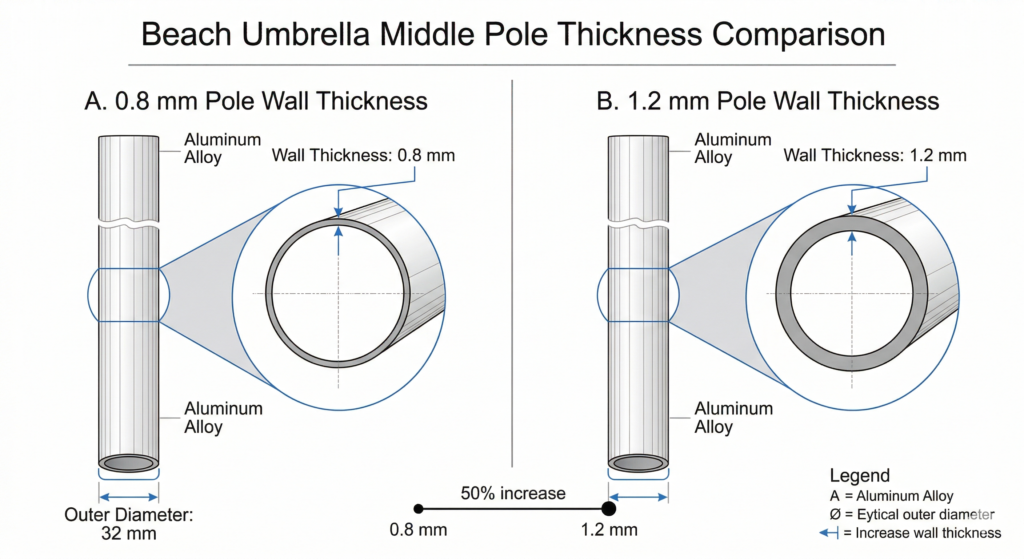
At IgerEnjoy, our rust-proofing protocol is engineered for 24/7 commercial exposure. We enforce a strict baseline of 1.0mm to 1.2mm wall thickness for all metal poles.
Furthermore, our surface treatment goes far beyond standard liquid painting. We utilize a 4-stage phosphoric acid washing and degreasing process. This chemical wash penetrates the inner walls of the tube—a critical detail that trading companies ignore. After the acid wash, we apply a 60-80 micron layer of outdoor-grade powder coating. To verify the bond, our quality control technicians perform a Cross-Cut Test (ASTM D3359), ensuring the coating achieves a Grade 5B (maximum adhesion) rating, meaning no flaking will occur even under heavy abrasion.
Surface Treatment Comparison: Ordinary Paint vs. OEM Powder Coating
| Specification | Standard Trading Company (Liquid Paint) | IgerEnjoy OEM Standard (Powder Coating) |
| Metal Wall Thickness | 0.5mm – 0.6mm (High risk of snapping) | 1.0mm – 1.2mm (Commercial grade) |
| Pre-treatment | Simple wiping, basic dust removal | 4-stage phosphoric acid washing & degreasing |
| Coating Thickness | 20-30 microns | 60-80 microns (Outdoor-grade Polyester) |
| Salt Spray Test (ASTM B117) | Fails at 24 hours (Blistering/Rust visible) | Passes 72+ hours (Zero surface degradation) |
| Adhesion Testing | Cross-cut test: Grade 2B or worse | Cross-cut test: Grade 5B (Maximum adhesion) |
The Hidden ROI Math: How “Cheap” OEM Umbrellas Destroy Supermarket Margins
Procurement managers often focus exclusively on the FOB unit price, ignoring the catastrophic backend costs of poor material science. Let’s break down the real ROI of sourcing standard umbrellas versus IgerEnjoy’s engineered models.
Assume a supermarket orders 10,000 beach umbrellas. A trading company offers a price that is $1.50 cheaper per unit by using 0.6mm poles, recycled plastics, and liquid paint.
Upfront “Savings”: 10,000 units × $1.50 = +$15,000
However, due to rust, snapped poles, and faded fabrics, this batch experiences a conservative 15% return rate within the first 60 days of the summer season.
Defective Units: 1,500 umbrellas.
Cost of Reverse Logistics & Processing: Processing a bulky return (shipping, warehouse labor, customer service, and disposal) costs an average of $25 per unit.
Financial Loss: 1,500 units × $25 = -$37,500
By “saving” $15,000 upfront, the retailer actually loses $22,500 in net profit, not including the incalculable damage to consumer brand trust. IgerEnjoy’s stringent quality control effectively acts as an insurance policy, consistently keeping our B2B partners’ return rates below 0.5%.
What is the difference between real UPF 50+ fabric and cheap silver coating?
The fundamental difference lies in the material engineering: genuine UPF 50+ fabrics integrate UV-resistant chemical additives directly into the yarn extrusion process or utilize high-density weaving techniques, whereas cheap silver coatings are merely superficial liquid layers sprayed onto low-grade, loose-weave polyester.
The Illusion of Spectrophotometer Testing
Trading companies often manipulate buyer trust by showing a spectrophotometer reading of a brand-new silver-coated umbrella to prove its UPF 50+ rating. They will never show you the reading after a simulated weathering test.
In a real-world coastal environment, the combination of sea breeze, airborne sand, and salt acts as a constant abrasive. A standard silver-coated canopy will experience microscopic flaking and delamination after just 2 to 3 uses. Once the silver layer cracks, the UV protection immediately plummets from a claimed “UPF 50” to below UPF 15. This exposes end-users to severe sunburns and triggers immediate negative reviews for DTC brands.
IgerEnjoy’s AATCC 183 Compliance
At IgerEnjoy, our UPF 50+ certification follows the rigorous AATCC 183 standards, and crucially, we test the fabric after accelerated wear and washing cycles. For DTC brands aiming for a premium market position, we enforce a minimum of 180g high-density polyester or solution-dyed acrylic. These fabrics guarantee a Colorfastness to Light rating (ISO 105-B02) of Grade 4 or higher. This ensures the canopy will not fade, degrade, or lose its UV resistance even after 300+ hours of direct coastal sunlight.
Fabric Performance & Durability Comparison
| Specification | Cheap Silver Coating (Standard Market) | Real UPF 50+ (IgerEnjoy Premium Poly/Acrylic) |
| UV Protection Method | Superficial spray coating | High-density weave + ingrained UV inhibitors |
| Abrasion Resistance | Extremely poor (peels with sand friction) | Excellent (structural integrity maintained) |
| Colorfastness to Light | Fades rapidly (Grade 2-3) | Fade-resistant (Grade 4 to Grade 5) |
| Post-Wash UPF Rating | Drops below UPF 15 | Maintains UPF 50+ after standard washing cycles |
What quality standard checklist should I use for beach umbrella OEM sourcing?
A robust OEM quality standard checklist for beach umbrellas must evaluate three critical structural nodes: center pole integrity, rib flexibility under wind load, and plastic component UV resistance.
To eliminate high return rates and ensure seamless container loading, sourcing managers should mandate the following Pre-Shipment Inspection (PSI) parameters:
Center Pole & Tilt Mechanism Integrity: Verify the center pole wall thickness is strictly ≥1.0mm using digital calipers. If the umbrella features an adjustable tilt function, the zinc alloy joint must pass a minimum 500-cycle continuous bending test without jamming or showing signs of metal fatigue.
Rib Toughness (Wind Resistance): For coastal winds, fiberglass ribs are vastly superior to standard steel. Ensure a minimum solid fiberglass diameter of 6.0mm. During factory inspection, the ribs must withstand a 60-degree severe bend test without splintering or snapping. If the budget dictates steel ribs, verify the powder coating thickness is ≥60 microns via an electronic coating thickness gauge.
Plastic Hubs & Anchors: Specify 100% virgin Nylon or Polypropylene (PP) with integrated anti-aging (UV-stabilized) additives. Sourcing Trap: Many factories use secondary recycled plastics to cut injection molding costs. These recycled hubs will turn brittle and shatter within 60 days under intense UV exposure, causing the entire umbrella frame to collapse.
Conclusion
Sourcing beach umbrellas for harsh coastal environments leaves zero room for compromised materials. A 0.6mm center pole or a superficial silver coating will not only fail standard B2B quality checks but will actively destroy your brand’s profitability through crippling reverse logistics and return rates. True commercial viability requires rigorous engineering: strictly ≥1.0mm wall thicknesses, 4-stage phosphoric acid pre-treatments, fiberglass windproof ribs, and real AATCC 183 certified fabrics.
Stop gambling your margins on standard trading company catalogs that prioritize upfront savings over structural integrity. Partner with a genuine source factory that builds quality directly into the raw materials.
Contact IgerEnjoy today to request our verified Salt Spray Test reports, high-density UPF 50+ fabric swatches, or to discuss your specific OEM/ODM beach umbrella manufacturing requirements.
Frequently Asked Questions (FAQ)
How thick should the center pole be for a commercial beach umbrella?
For commercial or high-end retail beach umbrellas, the center pole wall thickness must be strictly ≥1.0mm (ideally 1.2mm for aluminum). Anything below this threshold (e.g., the standard 0.6mm used by cheap suppliers) risks snapping at the tilt mechanism or base under standard 15mph coastal winds.
What is the best fabric for fade-resistant beach umbrellas?
The most durable option is solution-dyed acrylic or high-density polyester (minimum 180g) integrated with UV inhibitors during the manufacturing process. These materials maintain a Colorfastness to Light rating of Grade 4+, retaining their genuine UPF 50+ protection even after prolonged exposure to salt and sun, unlike cheap superficial silver coatings that flake off.
How long should an OEM beach umbrella last in a salt spray test?
According to ASTM B117 laboratory standards, a commercially viable beach umbrella metal frame should withstand a Neutral Salt Spray (NSS) test for a minimum of 48 hours without blistering. IgerEnjoy’s premium outdoor-grade powder coating, backed by a 4-stage phosphoric acid wash, routinely passes 72+ hours of testing.