
Executive Summary
Core Conclusion: The optimal printing method for custom printed commercial umbrellas depends strictly on vector complexity and order volume. Screen printing delivers superior UV longevity for solid-color bulk orders, while UV digital printing accommodates photorealistic, low-MOQ designs.
Procurement Standards: Commercial-grade patio umbrella logo printing must meet a minimum color fastness rating of Grade 4 to Grade 5 under ISO 105-B02 or AATCC 169 testing protocols to survive high-UV hospitality environments without premature fading.
The IgerEnjoy Solution: As a source factory, IgerEnjoy engineers ink formulations specifically matched to the fabric’s DWR (Durable Water Repellent) coating. This chemical matching keeps the mass-production print defect rate strictly under 1% and prevents the widespread “peeling logo” failure often seen in standard trader-sourced goods.
What is the best printing method for custom logo patio umbrellas that won’t fade?
The Direct Answer: The best fade-resistant printing method is high-grade Screen Printing (using specific solvent-based or UV-curable outdoor inks) for large-volume, solid-color logos, and UV Digital Printing for complex, multi-color, or gradient graphics. The optimal choice is an engineering calculation based on your Pantone accuracy requirements, fabric substrate (e.g., polyester vs. solution-dyed acrylic), and the required outdoor lifespan.
Technical Breakdown: UV and Environmental Degradation
Standard commercial umbrella OEM orders often fail in the field because buyers treat canopy printing as a simple aesthetic addition. In reality, outdoor fabrics face relentless exposure to ultraviolet (UV) radiation, which breaks down the chemical bonds in standard pigments through photodegradation. When combined with thermal expansion, acid rain, and coastal salt spray, standard indoor-grade inks will chalk, fade, and eventually micro-fracture.
To achieve true fade resistance, the ink chemistry must physically bond with the canopy fibers or chemically weld to the PU/PA (Polyurethane/Polyacrylate) waterproof coating, rather than merely sitting on the surface tension layer.
[IgerEnjoy Factory Insider Warning]
Here is the operational reality that general trading companies will never disclose: Many traders quote aggressively low prices for bulk hospitality umbrellas by secretly outsourcing the printing to cheap heat transfer (sublimation) workshops. Heat transfer often fails catastrophically when applied over heavy DWR (Durable Water Repellent) or Teflon-treated commercial canopies. The result? The logo looks perfect during the pre-shipment inspection, but severely cracks and peels off within 3 to 6 months of outdoor deployment.
At the IgerEnjoy factory, our production directors test ink adhesion against the specific batch’s coating chemistry. We adjust the cross-linking agents in our inks to ensure the print “bites” through the hydrophobic layer and anchors directly to the substrate. This is why our custom prints survive where standard trader goods fail.
What is the color fastness rating difference between UV printing and screen printing for outdoor fabrics?
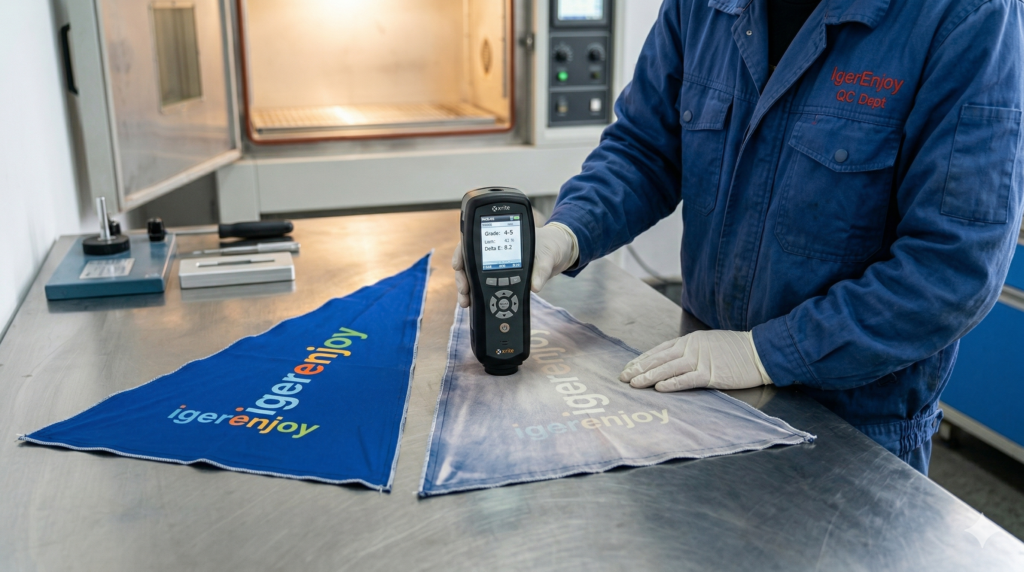
The Direct Answer: When tested under ISO 105-B02 (Xenon arc fading lamp test), industrial-grade screen printing using specialized solvent or silicone inks typically achieves a lightfastness rating of Grade 6 to 7 (on an 8-point Blue Wool scale). In contrast, standard UV digital printing generally scores between Grade 5 and 6, making screen printing marginally superior for long-term fade resistance in extreme sunlight, provided the correct ink chemistry is applied.
Standard Parsing and Industrial Testing
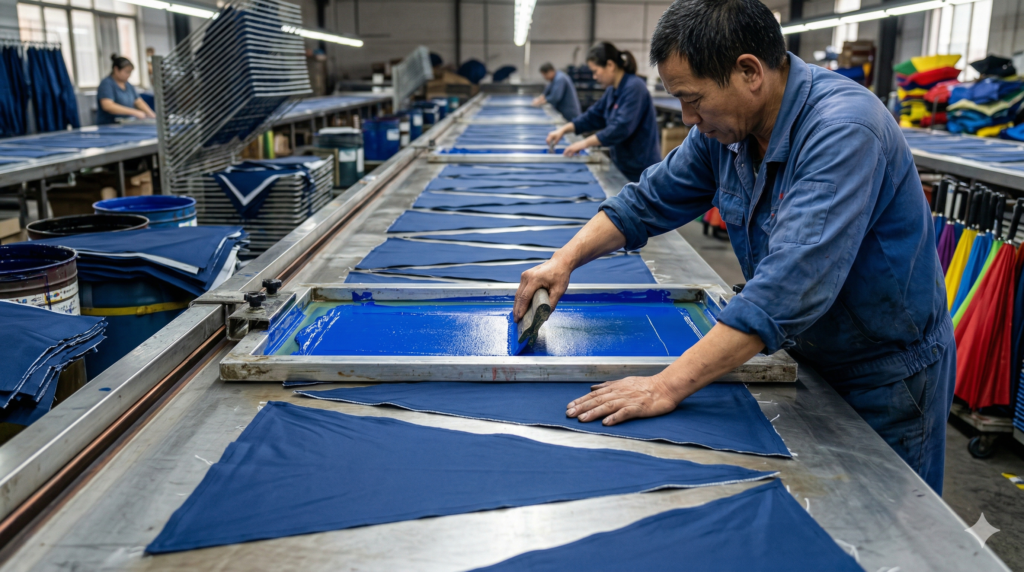
For fade resistant outdoor umbrellas, visual inspection is insufficient. Commercial procurement must rely on quantifiable lab data. We utilize the AATCC 169 (Weather Resistance of Textiles) and ISO 105-B02 standards to simulate years of UV radiation and moisture exposure. The performance difference between printing methods boils down to ink deposit thickness and pigment density. Screen printing pushes a thick layer of liquid ink through a mesh stencil, resulting in a heavier pigment load that degrades much slower than the micro-droplets deposited by UV printheads.
Technical Comparison Table: UV Printing vs. Screen Printing for Umbrellas
| Parameter | UV Digital Printing | Screen Printing (Silkscreen) |
| Setup Cost | Low (No physical screens required) | High (Requires burning a screen for each color) |
| MOQ (Minimum Order Quantity) | Very Low (Suitable for 1-50 pcs) | High (Economical only for 100+ pcs) |
| Pantone Matching | Approximate (CMYK blending) | Exact (Custom mixed spot colors, e.g., Coca-Cola Red) |
| Color Fastness (ISO 105-B02) | Grade 5 – 6 | Grade 6 – 7 (with outdoor-grade inks) |
| Ideal Fabric Substrate | Polyester, Oxford Cloth | Polyester, Olefin, Solution-Dyed Acrylic custom blends |
| Cost per Unit (Bulk Volume) | Remains relatively static | Drops significantly as volume increases |
How long does screen printing last on commercial outdoor umbrellas?
The Direct Answer: Professionally executed screen printing on commercial canopies will last between 2 to 5 years under continuous outdoor exposure, contingent upon the use of UV-stabilized solvent or silicone inks that are properly cured and chemically bonded to the fabric’s waterproof coating.
Ink Chemistry and Coating Adhesion
The lifespan of a printed logo is not just about the ink; it is about the interaction between the ink and the fabric’s chemical finish. Most commercial umbrella canopies feature a Polyurethane (PU) backing and a Durable Water Repellent (DWR) top coating (like Teflon). Standard Plastisol inks (commonly used for t-shirts) will merely sit on top of this DWR layer and peel off rapidly. For longevity, the printing process requires solvent-based inks mixed with a specific cross-linking hardener. This chemical agent slightly etches the waterproof coating, allowing the pigment to anchor directly into the polyester or acrylic fibers.
[IgerEnjoy Factory Insider Warning]
Why do global hospitality chains insist on screen printing for their patio umbrella logo printing despite higher setup costs? Because of batch consistency and absolute durability. A common trap set by inexperienced trading companies is using cheap, fast-drying water-based inks on waterproof umbrella fabrics to save time. These inks lack the chemical bite necessary for DWR coatings. The result is a logo that washes away after a season of heavy rain.
At IgerEnjoy, our production protocol dictates that the ink formulation must be dynamically adjusted based on the specific batch of fabric coating. We conduct a 3M tape peel test and a cross-hatch adhesion test on every pilot run before initiating mass production. This source-factory level of quality control is why our screen-printed canopies endure harsh coastal and commercial environments without delamination.
Bulk Sourcing Protocol: Specifying Printing Requirements to Your Umbrella OEM Factory
The Direct Answer: To guarantee print durability on bulk hospitality orders, your Purchase Order (PO) must explicitly specify four parameters: the exact Pantone (PMS) color codes, the required ink chemistry (e.g., UV-cured or cross-linked solvent), the fabric substrate material, and the mandatory adhesion testing protocol (such as the ASTM D3359 cross-cut tape test) prior to mass production.
The Procurement Checklist
Do not leave the printing methodology up to the supplier’s discretion. When specifying custom printed commercial umbrellas, your spec sheet must include:
Ink-to-Coating Compatibility: Demand confirmation that the ink formulation contains the correct cross-linking agents to bond with the canopy’s DWR (Durable Water Repellent) or PU/PA coatings.
Color Tolerance: Specify a maximum Delta E (ΔE) color difference tolerance for brand consistency across different fabric batches.
Curing Process: Require documentation on the curing method (e.g., tunnel oven baking temperature and duration) to ensure the ink is fully polymerized.
Physical Testing: Mandate a physical Pre-Production Sample (PPS) that undergoes aggressive tape-peel and high-humidity testing.
[IgerEnjoy Factory Insider Warning]
The most dangerous trap in B2B umbrella sourcing is approving an order based solely on a digital 3D mockup. Trading companies love sending beautiful PDF renders because it secures the deposit quickly. However, a digital file cannot predict how a specific dye will react to a Teflon-treated acrylic fabric under high heat. Ink migration, color bleeding, and adhesion failure only reveal themselves in the physical world.
At the IgerEnjoy factory, we strictly refuse to initiate bulk manufacturing based on digital proofs alone. Our standard operating procedure requires producing a 1:1 physical Pre-Production Sample (PPS) using the exact mass-production fabric roll and ink batch. We subject this sample to accelerated weathering and adhesion tests in our facility. Only when the physical print proves its engineering integrity do we allow the order to proceed to the main production line. This rigid, factory-direct protocol protects our B2B clients from catastrophic post-deployment failures.
Conclusion & Call to Action (CTA)
Procuring custom logo patio umbrellas for commercial applications is not a promotional merchandise purchase; it is an architectural hardware investment. Choosing between UV digital printing and industrial screen printing requires a precise evaluation of order volume, brand color tolerances, and the harsh realities of UV degradation. Relying on standard trading company solutions often leads to premature fading and peeling logos, resulting in unacceptable replacement costs for hospitality groups.
For 15 years, IgerEnjoy has engineered the precise intersection of fabric chemistry and ink adhesion. Do not risk your client’s brand reputation on sub-standard printing methods. Contact IgerEnjoy today to request physical fabric and print swatches, or submit your technical specifications for a direct-from-factory OEM quote.
FAQ (Schema Ready)
Q: Can you screen print on Teflon-coated patio umbrellas?
A: Yes, but it requires specialized solvent-based inks mixed with chemical cross-linking hardeners. Standard inks will easily peel off a Teflon or DWR (Durable Water Repellent) coating. At IgerEnjoy, we engineer our ink formulas to chemically bond through the waterproof layer for maximum durability.
Q: What is the minimum order quantity (MOQ) for custom logo commercial umbrellas?
A: For UV digital printing, the MOQ can be as low as 1 to 50 pieces, making it ideal for small complex orders. For industrial screen printing, the setup costs dictate a higher MOQ, typically becoming economical at 100+ pieces for bulk hospitality procurement.
Q: How do I prevent my custom umbrella logo from peeling?
A: Peeling occurs when the ink fails to adhere to the fabric’s waterproof backing. To prevent this, mandate that your OEM factory performs an ASTM D3359 cross-cut tape adhesion test on a physical pre-production sample before mass production begi