
Executive Summary
For commercial patio umbrella bulk orders, fabric fade resistance directly impacts your Total Cost of Ownership (TCO) and aftermarket warranty claims. Standard piece-dyed polyester typically fades within 3 to 6 months in high-UV environments like coastal resorts. The industry standard for maximum longevity is 100% Solution-Dyed Acrylic, which retains critical colorfastness for 3 to 5 years. At IgerEnjoy, our engineering data confirms that switching from coated polyester to solution-dyed fabrics reduces canopy replacement and labor costs by over 70% across a five-year lifecycle for hospitality clients. This comprehensive 2026 guide breaks down the chemical extrusion differences, Xenon Arc testing standards, financial ROI models, and OEM contract specifications required to eliminate premature UV degradation in your supply chain.
What is the best fade-resistant fabric for commercial patio umbrellas?
Direct Answer: The absolute best fade-resistant fabric for commercial outdoor umbrellas is 100% Solution-Dyed Acrylic, followed by high-grade Solution-Dyed Olefin as a mid-tier commercial alternative. Standard polyester, nylon, and Oxford fabrics are fundamentally unsuitable for continuous commercial sun exposure and will result in rapid color loss.
When sourcing patio umbrellas for hotels, restaurants, or beach resorts, the canopy material dictates the product’s lifespan and your brand’s visual reputation. B2B buyers must move past basic weight specifications (like 280g/m²) and focus entirely on the chemical dyeing method.
Fabric Specification & Lifespan Comparison Matrix
| Fabric Type | Coloring Process | Est. Fade-Free Lifespan (High UV) | Commercial Suitability | Factory Cost Index |
| Solution-Dyed Acrylic | Pre-spinning liquid pigment | 3 – 5 Years | Excellent (Hotels/Resorts) | $$$ |
| Solution-Dyed Olefin | Pre-spinning liquid pigment | 1 – 2 Years | Good (Mid-range B2B) | $$ |
| Piece-Dyed Polyester | Post-weaving dip dye | 3 – 6 Months | Poor (Retail/Promotional) | $ |
| Oxford Fabric / Nylon | Surface printed/coated | < 3 Months | Unacceptable | $ |
IgerEnjoy Factory Insider Tip: Many trading companies will pitch “heavy-duty 280g/m² polyester with UV coating” as a premium option. What they don’t tell you is that heavy basis weight does not equal high colorfastness. Low-end factories often use excessive surface PU (Polyurethane) or PA (Polyacrylate) coatings to artificially increase the fabric weight and stiffness to pass initial inspection. Under continuous UV radiation and rain, this thick chemical coating will harden, crack, and peel off within 90 days, leaving a faded, compromised canopy. Always specify the dyeing method, not just the raw fabric weight.
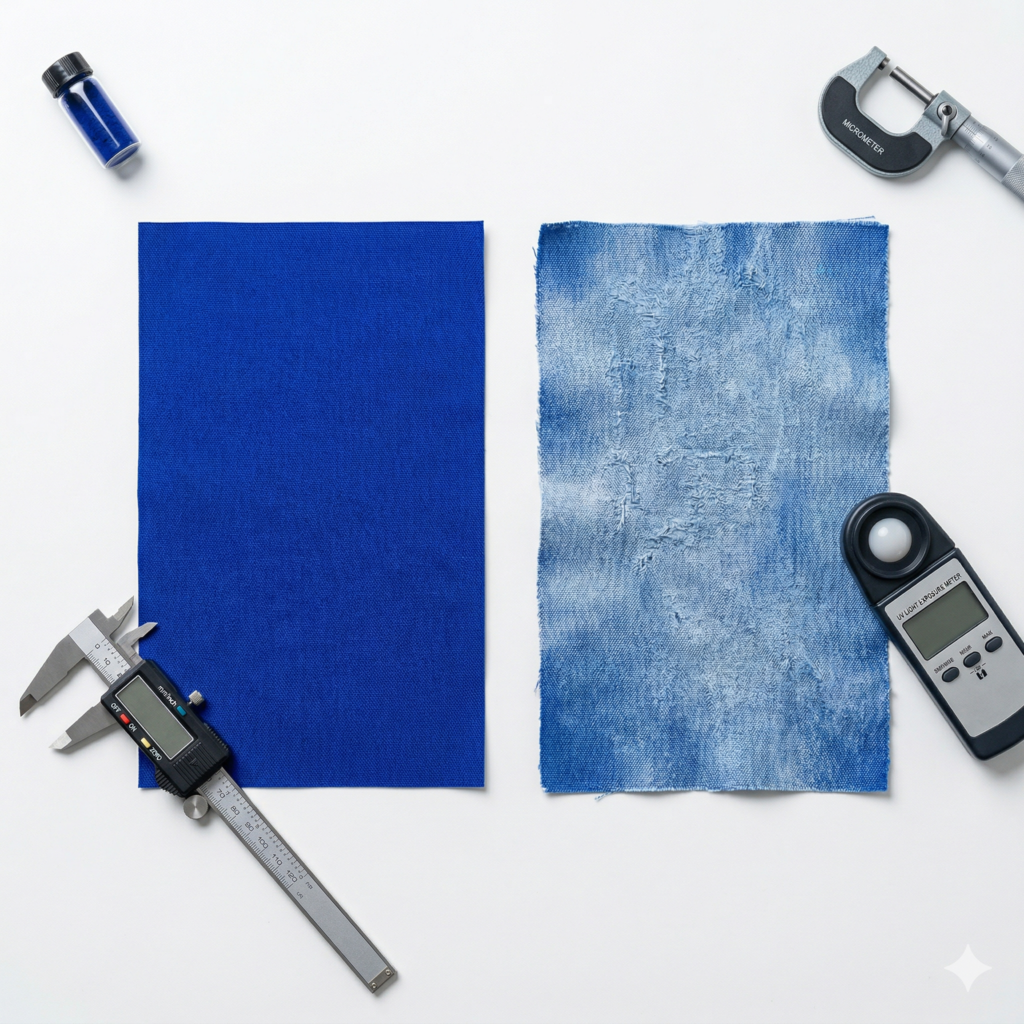
How long does solution-dyed acrylic last compared to standard polyester outdoors?
Direct Answer: In extreme sun environments (e.g., Florida, Australia, or the Middle East), standard piece-dyed polyester shows severe, irreversible fading within 3 to 6 months. In stark contrast, premium solution-dyed acrylic guarantees 3 to 5 years of color retention under identical atmospheric conditions.
The fundamental difference in patio umbrella fabric fade resistance lies in the manufacturing chemistry, specifically the yarn extrusion process.
The “Radish” Method (Standard Polyester): Traditional polyester is extruded as a plain white filament, woven into canvas, and then dipped into a hot dye bath (piece-dyed). The color pigment only adheres to the outer microscopic surface of the fibers—much like the red skin of a radish with a white center. Once UV rays break down this thin surface layer, the white core is exposed, causing the fabric to appear severely faded.
The “Carrot” Method (Solution-Dyed Acrylic): In the solution-dyed process, UV-stable, high-grade color pigments are mixed directly into the liquid acrylic polymer before it is extruded into solid yarn. The color permeates all the way through the core of the fiber—like a carrot. Even as the very outer microscopic layer undergoes natural weathering, the exposed layer beneath is exactly the same color.
Furthermore, UV degradation does not just destroy aesthetic color; it breaks down the polymer chains (photodegradation), severely reducing the fabric’s tensile and tear strength. Standard polyester becomes brittle and tears easily in standard wind conditions after a single season of sun exposure. Solution-dyed acrylic maintains its structural polymer integrity, significantly reducing physical tearing risks in commercial settings.
Inside the Testing Lab: What is the standard colorfastness grade for heavy-duty beach umbrellas?
Direct Answer: For commercial-grade beach and patio umbrellas, your mandatory specification must be a colorfastness to light rating of Grade 7-8 under the ISO 105-B02 standard (European), or Grade 4-5 under the AATCC Test Method 16.3 (American). Accepting any grade lower guarantees visible fading within a single summer season.
To accurately measure patio umbrella fabric fade resistance, legitimate factories and third-party laboratories do not rely on natural sunlight, which is inconsistent. Instead, we use Xenon Arc Fadeometers to simulate accelerated weathering and continuous UV exposure under strictly controlled environments.
During an ISO 105-B02 test, the fabric is exposed to a Xenon arc lamp that closely replicates the full spectrum of natural sunlight. The test maintains a specific Black Standard Temperature (typically $65^\circ C$) and precise relative humidity.
ISO 105-B02 (Blue Wool Scale): Graded logarithmically from 1 to 8. Grade 8 represents maximum light fastness. A rating of Grade 7 means the fabric requires roughly twice the UV exposure to fade as a Grade 6 fabric. For high-end hospitality environments, Grade 7 or 8 is non-negotiable.
AATCC Test Method 16.3: Graded from 1 to 5 using the Gray Scale for Color Change. Grade 5 indicates excellent resistance to fading.
IgerEnjoy Factory Insider Tip: A critical trap for buyers is confusing “UPF rating” with “Colorfastness.” A supplier might loudly guarantee “UPF 50+ UV Protection.” However, UPF (Ultraviolet Protection Factor) only measures how much UV radiation passes through the fabric to burn human skin; it has absolutely zero correlation with whether the fabric itself will lose its color. Always demand the ISO 105-B02 or AATCC 16 test reports. If a supplier evades this and only talks about UPF, they are substituting cheap piece-dyed polyester to increase their profit margins.
The Financial Reality: Total Cost of Ownership (TCO) Analysis for Commercial Buyers
Direct Answer: While solution-dyed acrylic requires a higher initial capital outlay, it reduces the Total Cost of Ownership by eliminating annual replacement canopies and associated maintenance labor, achieving a positive ROI crossover point typically within month 14 of deployment.
For B2B buyers outfitting a 500-lounger resort or a restaurant chain, aesthetic degradation is a financial liability. Let us look at a conservative 5-year TCO model comparing standard polyester versus solution-dyed acrylic for a 500-unit deployment:
| Cost Metric (500 Units) | Standard Polyester (Piece-Dyed) | Solution-Dyed Acrylic |
| Initial Unit Cost (Est.) | $45 per umbrella | $85 per umbrella |
| Initial Capital Expenditure | $22,500 | $42,500 |
| Replacement Frequency | Annually (due to fading/tearing) | None required for 5 years |
| Replacement Canopy Cost | $20 / unit / year | $0 |
| Maintenance Labor to Swap | $10 / unit / year | $0 |
| Total 5-Year Maintenance | $60,000 (4 replacement cycles) | $0 |
| Total 5-Year TCO | $82,500 | $42,500 |
By specifying solution-dyed acrylic from a source factory like IgerEnjoy, the buyer in this scenario saves exactly $40,000 over 5 years, while maintaining a premium, unfaded aesthetic for their guests continuously. The “cheap” polyester option ultimately costs nearly double due to the hidden labor and replacement material costs.
The “Frame Mismatch” Trap: Don’t Put Premium Fabric on a Cheap Skeleton
Direct Answer: Upgrading to a 5-year solution-dyed acrylic canopy is a waste of capital if the factory mounts it on a 0.8mm steel or low-grade aluminum frame that will snap or rust within 6 months. Premium fabric mandates commercial-grade hardware.
A common industry pitfall occurs when B2B buyers aggressively negotiate for premium fabric but ignore the umbrella’s skeletal structure to offset the cost. Solution-dyed acrylic is heavy, dense, and structurally sound. In high winds, it will act as a powerful sail. If the frame cannot handle the wind load, the umbrella will fail structurally long before the fabric fades.
To match the 5-year lifespan of solution-dyed acrylic, your OEM specifications for the frame must include:
Center Pole: Minimum 1.5mm wall thickness extruded aluminum (6063-T5 alloy) or 2.0mm marine-grade stainless steel (SS316 for coastal areas). Never accept 0.8mm or 1.0mm steel, which will bend and rust.
Ribs: Minimum 12mm solid fiberglass ribs or reinforced aluminum profiles with heavy-duty brackets. Hollow steel ribs will buckle under the tension of an acrylic canopy in heavy wind.
Hardware: All screws, rivets, and pulley components must be stainless steel (SS304 or SS316) to prevent rust bleeding onto the expensive canopy.
How to Spec Anti-Fade Requirements in Your OEM/ODM Umbrella Contract?
Direct Answer: To protect your bulk investment, your manufacturing contract must explicitly define the yarn extrusion process, the exact light fastness standard, the fabric weight, and the surface finishing parameters, completely avoiding vague terms like “outdoor UV fabric.”
When drafting your purchasing agreement with an OEM factory, mandate the following technical parameters to ensure consistent, legally binding batch quality:
Material Designation: Explicitly state “100% Solution-Dyed Acrylic” (or “100% Solution-Dyed Olefin” for mid-tier projects). Never accept the word “Polyester” if fade resistance is your primary goal.
Colorfastness Standard: Specify “Minimum ISO 105-B02 Grade 7” or “AATCC 16.3 Grade 4.” Demand pre-production lab reports.
Fabric Weight: For solution-dyed acrylic, the optimal balance of tensile strength and canopy foldability is 280g/m² to 300g/m².
Surface Finish: Request a Fluorocarbon (Teflon-style) water and stain-repellent finish. Explicitly prohibit thick, cheap PU (Polyurethane) coatings, which chemically degrade and trap heat.
At IgerEnjoy, our 15 years of factory floor experience mean we don’t just assemble umbrellas; we engineer the entire supply chain. We provide our B2B clients with transparent material sourcing, verifiable Xenon Arc testing data, and commercial-grade frame matching before mass production begins, ensuring zero surprises upon container arrival.
Conclusion: Engineered for Longevity, Built for Your Brand
Ultimately, specifying the correct fabric for your commercial patio umbrellas is a mathematical and engineering decision, not just an aesthetic one. While piece-dyed polyester offers a lower upfront cost, the annualized replacement expense due to rapid UV degradation destroys profit margins for hospitality clients and damages your brand reputation. By upgrading to 100% solution-dyed acrylic, enforcing strict ISO 105-B02 colorfastness standards, and matching the fabric to a heavy-duty frame, you secure a reliable 3-to-5-year lifespan for your outdoor assets. At IgerEnjoy, we don’t just supply umbrellas; we engineer reliable, compliant, and highly durable shading solutions directly from the factory floor.
Ready to upgrade your outdoor umbrella supply chain? Contact the IgerEnjoy engineering team today for a technical consultation, fabric swatch samples, or a complete OEM/ODM manufacturing quote.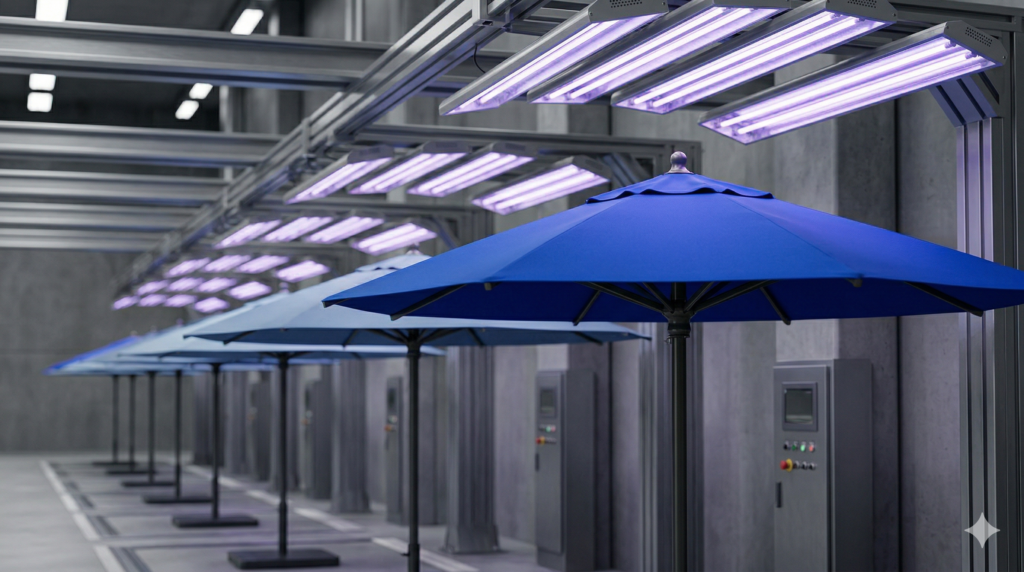
Frequently Asked Questions (FAQ)
Q: Why do commercial beach umbrellas fade so quickly in coastal areas?
A: Commercial beach umbrellas fade quickly when manufactured using standard piece-dyed polyester. In coastal areas with a high UV index and salt spray, the surface dye breaks down rapidly, usually within 3 to 6 months. To prevent this, bulk buyers must specify solution-dyed acrylic, where the UV-stable pigment is integrated directly into the yarn’s core prior to extrusion.
Q: Can you clean solution-dyed acrylic patio umbrellas with bleach?
A: Yes. Because the color in solution-dyed acrylic is chemically bonded inside the fiber during the yarn extrusion process, it is inherently bleach-cleanable. This makes it the standard choice for commercial properties that need to remove tough stains, bird droppings, mold, or mildew without causing the fabric to lose its baseline color.
Q: What is the B2B price difference between polyester and solution-dyed acrylic?
A: Solution-dyed acrylic typically costs nearly double compared to standard polyester at the initial factory purchasing level. However, because acrylic lasts 3 to 5 years outdoors compared to polyester’s 3 to 6 months, the long-term ROI is significantly higher. Upgrading eliminates the high labor and material costs associated with seasonal canopy replacements, reducing 5-year TCO by up to 50%.