
For global B2B buyers, importing beach umbrellas from China is a high-reward venture that requires meticulous planning. As we move into 2026, the outdoor furniture industry is shifting toward more stringent safety standards, eco-friendly materials, and complex tax regulations.
Whether you are a seasoned importer supplying hotel chains, a procurement officer for a resort, or a brand owner launching on Amazon, this comprehensive guide will walk you through every technicality—from the production line at IgerEnjoy to your local warehouse. We will cover HS codes, the new ASTM safety standards, freight optimization, and quality control strategies that protect your margins.
1. Product Classification: HS Codes & Duty Rates
Before you can calculate your landed cost, you must correctly define your product for customs authorities.
The Primary HS Code: 6601.10
The universal Harmonized System (HS) code for beach umbrellas is 6601.10. This category covers “Garden or similar umbrellas.”
Why it matters: Misclassifying your product (e.g., as “Rain Umbrellas” under 6601.99) can lead to retroactive fines and shipment delays.
Components: If you import separate bases, they fall under different codes (e.g., Cast Iron bases: 7326.90; Plastic bases: 3926.90).
2026 Duty Context
When importing beach umbrellas from China, the duty rate depends heavily on your destination and current trade agreements:
USA: Subject to the standard duty plus potential Section 301 tariffs.
EU: Standard duty applies, but watch out for Anti-Dumping Duties (ADD) if sourcing from non-verified factories. At IgerEnjoy, we ensure all documentation is compliant to minimize clearance risks.
2. Material Science: Specifying the Right Umbrella for 2026
Your choice of materials directly impacts your shipping weight, durability, and ultimately, your customer satisfaction. At IgerEnjoy, we prioritize materials that balance durability with logistics efficiency.
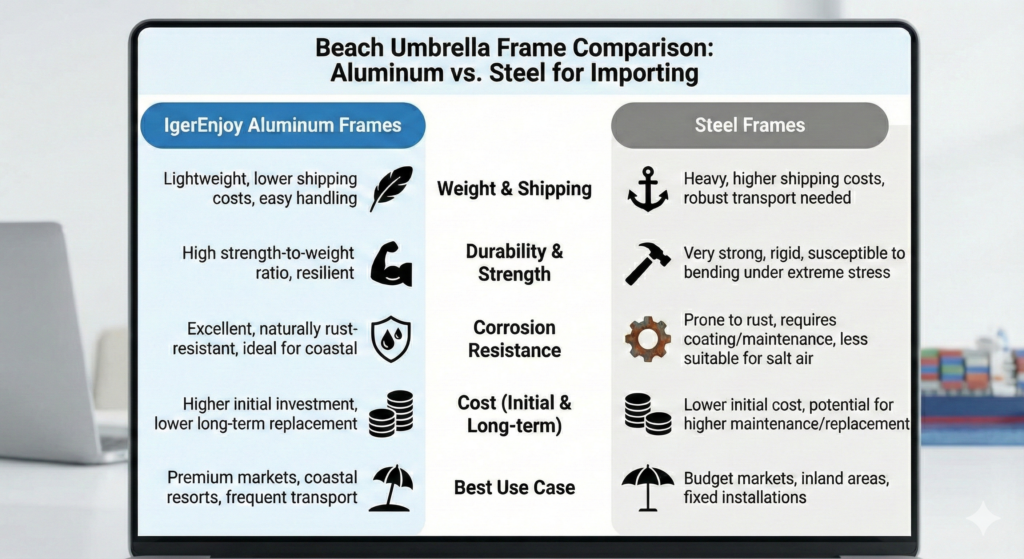
Frame Materials: The Core of Durability
| Material | Weight (Avg) | Corrosion Resistance | Wind Performance | Target Market |
| Powder-Coated Steel | Heavy | Low (Rust-prone) | Moderate | Budget Retail / Promotional |
| Anodized Aluminum | Light | High (Salt resistant) | High | Mid-to-High End Brands |
| Fiberglass Ribs | Ultra-Light | Total | Superior (Wind-flex) | Professional Rentals / Coastal Areas |
| FSC Hardwood | Heavy | Moderate | Low (Rigid) | Boutique Hotels / Eco-Luxury |
IgerEnjoy Insight: For 2026 orders, we strongly recommend Anodized Aluminum combined with Fiberglass Ribs. This hybrid structure offers the best strength-to-weight ratio, reducing your shipping costs per unit while meeting the durability expectations of premium buyers.
Fabric Innovations
Standard Polyester (160g/180g): Good for one season.
Solution-Dyed Polyester (2026 Trend): The color is locked into the fiber during extrusion. It resists fading for 3-5 years, a standard requirement for hospitality clients.
RPET (Recycled): Made from plastic bottles. Essential for European tenders requiring “Green Supply Chain” documentation.
3. The 2026 Logistics Framework: FCL vs. LCL
Logistics typically accounts for 15-25% of your total cost when importing beach umbrellas from China. Understanding container optimization is key to profitability.
Why 40HQ is the “King” Container
Beach umbrellas are “Volume Cargo,” meaning they bulk out before they weigh out (they take up space but aren’t extremely heavy).
20GP Container: Holds ~28 CBM. This is cost-inefficient for long items like umbrellas due to wasted overhead space.
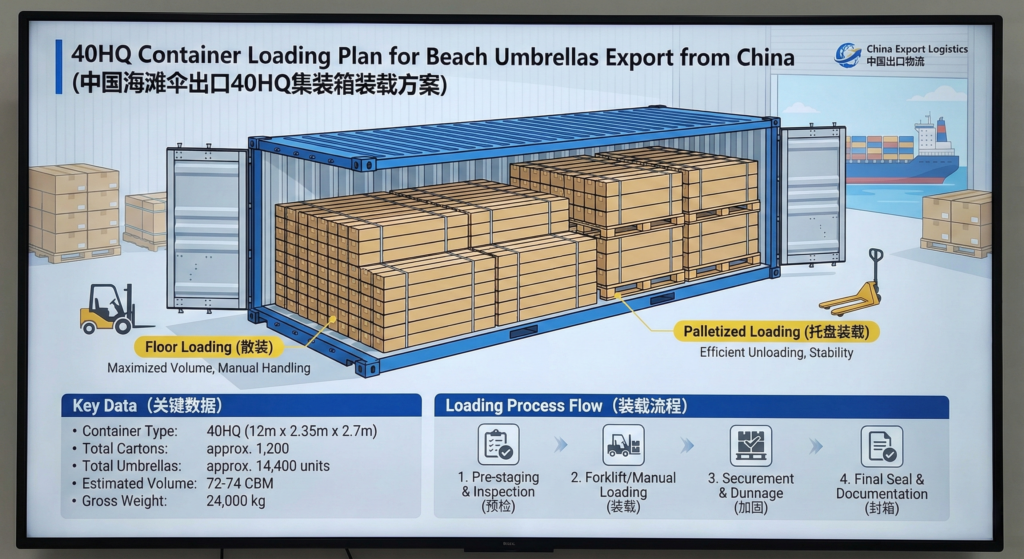
40HQ Container: Holds ~68 CBM.
Capacity: A standard 40HQ can hold approximately 1,000 to 1,200 commercial umbrellas (7ft – 8ft size).
Loading Strategy: Pallet vs. Floor Loading
Floor Loading: Workers hand-stack cartons to the ceiling.
Pros: Maximizes space (fit 15% more units).
Cons: Unloading takes 4-6 hours at your warehouse.
Pallet Loading: Cartons are strapped to pallets.
Pros: Unloading takes 30 mins with a forklift.
Cons: You lose valuable shipping volume and pay for the pallets.
4. Critical Safety Standard: ASTM F3681-25
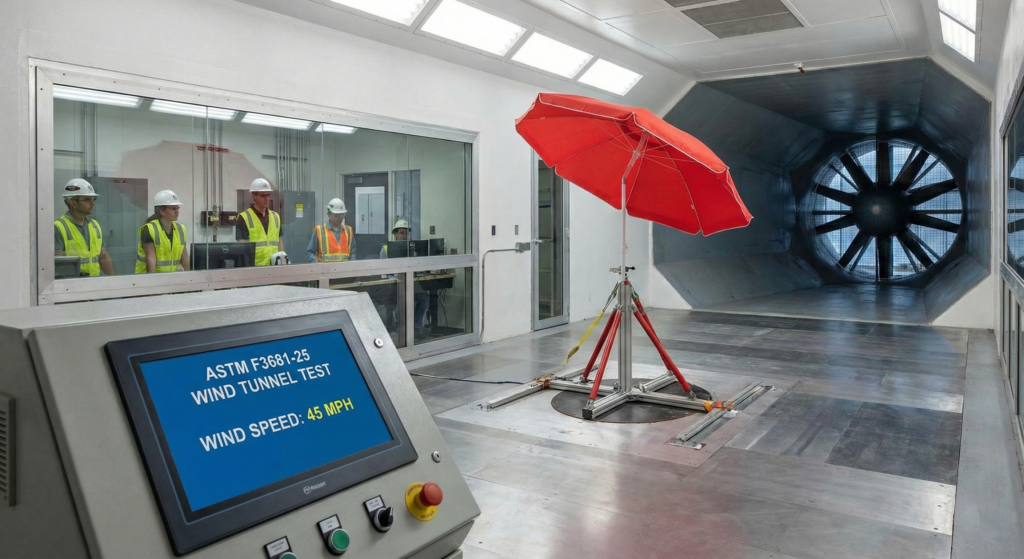
The biggest regulatory shift for 2026 is the enforcement of ASTM F3681-25 regarding wind safety.
The Risk: “Flyaway” umbrellas are a major liability issue for hotels and retailers.
The Requirement: Every umbrella imported into the US must now feature an integrated anchor system capable of resisting a 75lb (34kg) vertical pull force.
Testing: Your factory must provide a lab report proving the anchor holds in loose sand simulations.
IgerEnjoy Compliance: All our export-grade beach umbrellas are pre-tested against ASTM F3681-25 standards to ensure your brand is protected from liability.
5. The 8-Step Import Process with IgerEnjoy
To ensure a smooth operation, follow this proven roadmap we use with our global partners.
Step 1: Consultation & Specification
Don’t just browse catalogs. Work with IgerEnjoy’s team to define your wind-rating needs and UV-protection requirements.
Step 2: Prototyping
Pay for the sample. Test the tilt mechanism (the weakest point) and the fabric stitching. We provide samples within 7-10 days.
Step 3: Contract & Payment Terms
Standard: 30% Deposit, 70% Balance against Bill of Lading (B/L) copy.
Currency: Check if paying in RMB is cheaper than USD to avoid exchange rate buffers.
Step 4: Production & QC
Backed by our source factory (Shaoxing Yige), we implement a “Mid-Production Inspection” to check the rib assembly before the canopy is attached.
Step 5: Lab Testing
We can send one unit from the production line to SGS/Intertek for ASTM F3681-25 or EN 581 testing upon request.
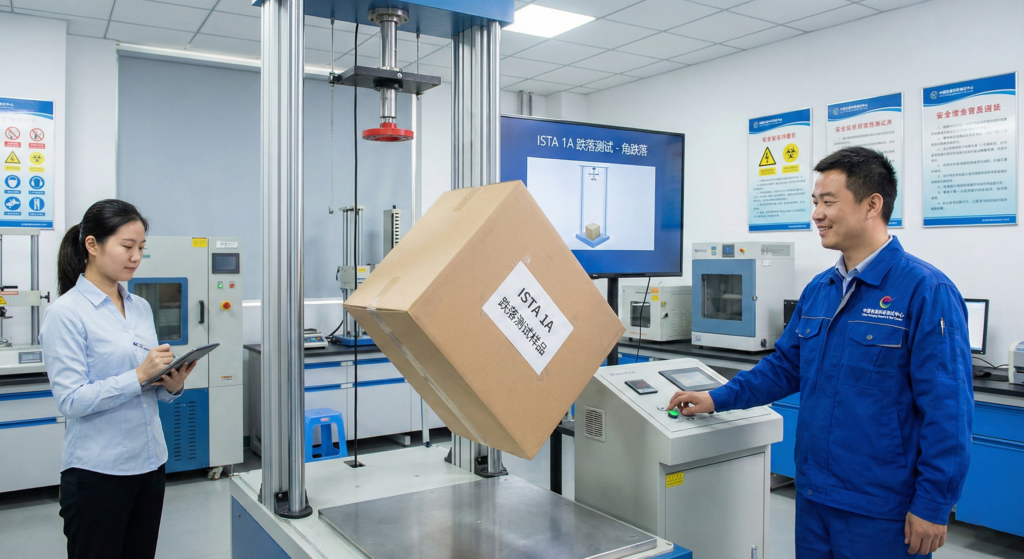
Step 6: Packaging Verification
Perform an ISTA 1A Drop Test. If the pole bends when the carton is dropped from 30 inches, reject the packaging.
Step 7: Booking Shipping
Book your vessel 14-21 days in advance during peak season (Jan-April) to secure a spot.
Step 8: Customs Clearance
Submit your ISF (Importer Security Filing) 24 hours before the ship leaves China to avoid penalties.
6. Managing Customs Duties & Taxes in 2026
For US Importers
Section 301: Be aware of the additional tariffs on Chinese goods.
Bonds: You will need a Continuous Customs Bond if you import more than once a year.
For EU Importers
CBAM (Carbon Border Adjustment Mechanism): Effective 2026, you must report the “embedded carbon” of the aluminum poles. IgerEnjoy provides the necessary emission data sheets for your declarations.
VAT: Remember that VAT is calculated on the CIF value (Cost + Insurance + Freight) + Duty.
7. Packaging Excellence: Preventing the “Bent Pole” Nightmare
Beach umbrellas are long and thin, making them vulnerable to “crushing” in a container.
The Solution: IgerEnjoy uses 5-layer Double-Wall Corrugated Cartons (BC Flute).
Reinforcement: Hard cardboard edge protectors are added to the master carton corners.
Inner Protection: Each umbrella is wrapped in a PE bag and separated by cardboard dividers to prevent metal-on-metal scratching.
Conclusion: Partnering for Profit with IgerEnjoy
Importing beach umbrellas from China is a complex operation, but with the right partner, it is highly scalable. By prioritizing compliance (ASTM standards), choosing the right materials (Aluminum/RPET), and optimizing your 40HQ load, you can secure a competitive edge in 2026.
IgerEnjoy combines the manufacturing strength of a source factory with the service quality of a global brand. We ensure your products arrive safe, compliant, and ready to sell.
Ready to launch your 2026 collection?
[Contact IgerEnjoy today] for a consultation on compliant, high-margin beach umbrella